
White paper
The Visual Asset Register: How 360-Degree Documentation Improves Work Orders, Inspections and Staff Handoffs
Nikolai Hanov
Published by Levaru
Full paper
The summary below covers the paper's key findings; the full text, methodology and figures are in the PDF.
Download the full white paper (PDF)The record of how a building actually works is one of a facility team’s most valuable assets, and in most organizations it barely exists as a record at all. Asset data sits in CMMS or IWMS text fields; drawings and closeout documents sit on shared drives, often several renovations out of date; procedures live in O&M binders; and the most operationally valuable layer — which panel feeds which wing, which valve isolates which riser, what the mechanical room looks like behind the locked door — lives only in the memories of the most experienced people on the team. None of that record is spatial, and only the last of it can answer the question every work order, inspection and handoff eventually asks: what does this space actually look like, and where exactly is the thing that matters?
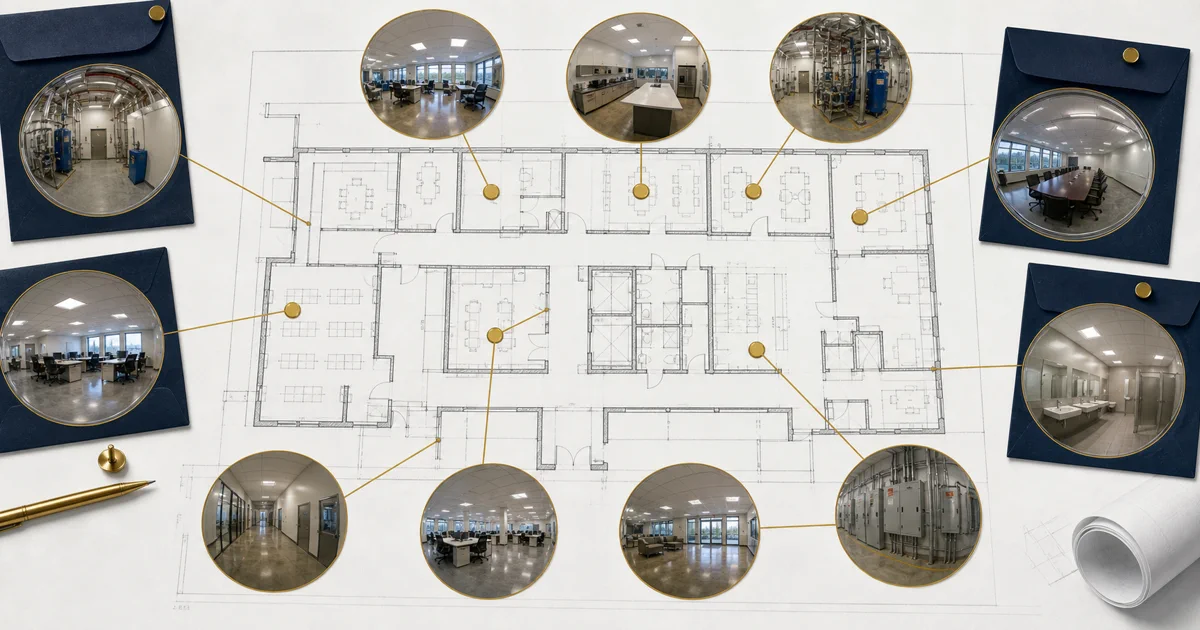
The Visual Asset Register defines a practical answer to that gap. A Visual Asset Register (VAR) is a spatially indexed, time-stamped collection of 360-degree captures of a facility, linked to asset records and maintained on a defined re-capture cadence under documented governance — so that any authorized person can view any covered space as it existed on any capture date. It sits deliberately between the photo folder and the engineering-grade digital twin: far more useful than the former, far less costly than the latter.
Why now
Hanov frames the case around three converging pressures, each supported by published figures the paper cites rather than its own. The first is workforce exit: a study cited in IFMA’s Facility Management Journal found that 31 percent of facility management employees are older than 55 and eligible to retire between 2022 and 2037, and at the University of Tennessee, Knoxville, a facilities department of roughly 600 staff maintaining more than 250 buildings recorded 97 retirements between 2020 and 2025. Each departure removes located knowledge that was never written down — because it never needed to be while its holder was one radio call away. The second is time lost to information hunting: McKinsey estimated interaction workers spend about 19 percent of the week searching for information, and a 2023 Quickbase survey found 53 percent of respondents chasing information more than 10 hours a week. Facility work adds a physical dimension, since that search happens on foot and in repeat site visits. The third is backlog and audit pressure: Gordian’s State of Facilities in Higher Education puts deferred capital renewal on North American campuses at US$156 per gross square foot, and the bodies that fund, insure and audit facilities are responding by demanding better, dated, defensible condition evidence.
What makes it a register, not a photo pile
The technology is deliberately modest — consumer- and prosumer-grade 360-degree cameras plus the labor to walk the spaces. What turns the imagery into a register is five properties: spatial indexing (every capture anchored to a floorplan position or room, navigated by walking the plan rather than scrolling a folder of files named IMG_4471); time-stamping and versioned re-capture (captures dated and retained, so the register holds each space’s history, not only its latest state); asset linkage (panoramas tied to CMMS/IWMS asset identifiers, so a work order can open onto the room and an asset record onto its surroundings); governed access (role-based permissions and documented handling for sensitive areas); and defined cadence and ownership (a named owner and a written re-capture schedule tuned to space criticality — without cadence, a register decays into an archive). The paper is equally clear about what a VAR is not: it provides no measurement-grade geometry unless built from scans, carries no live telemetry, and is a record of appearance and location, not of performance.
Three pillars
The bulk of the paper examines the three activities named in its title, because they are where the gap costs most and a register pays back first.
Work orders. Walking a corrective order’s lifecycle — triage, assignment, execution, vendor dispatch, verification — Hanov shows how many steps depend on knowing what a space looks like. With the relevant dated capture open, a coordinator can often identify the likely source, trade and access route before dispatch; a VAR-linked order lets the technician arrive already oriented; annotated captures answer the “which valve isolates this run” questions that otherwise go to a veteran by phone; and governed vendor access allows accurate quoting without a preliminary truck roll. The paper names four measurable metrics — time-to-locate, first-time fix rate, repeat visits attributable to missing information, and pre-work vendor visits — and pointedly declines to claim an industry benchmark, insisting the correct benchmark is the team’s own baseline, measured before a pilot and again after.
Inspections and compliance. The pillar rests on one mechanism: same-viewpoint re-capture. Photograph a space from the same positions on a schedule and condition change stops being a matter of recollection and becomes visible — two dated panoramas side by side. That upgrades condition assessment and capital planning (assessors, leadership and finance see the dated imagery behind a spreadsheet adjective), life-safety and access checks, insurance, warranty and dispute evidence (pre-loss and hand-back condition become lookups rather than arguments), and transitions of responsibility. A register also exposes verification recency — a coverage map of capture dates reveals the rooms nobody has entered in two years, which is itself a finding. Hanov keeps the pillar honest: imagery documents appearance, not performance, and a register whose newest capture predates a renovation is a liability in a dispute, not an asset.
Staff handoffs and knowledge continuity. What leaves when a 30-year technician retires is more specific than “experience” — it is located knowledge, real and operational and almost never written down because prose is a poor medium for it (nobody writes paragraphs about ceiling tiles; people point). An annotated register converts pointing into a record that survives the walker, benefiting retirement and succession, new-hire onboarding, vendor and contract transitions, and emergency coverage. Hanov proposes a simple heuristic, the Handoff Test: if the most experienced technician were unreachable for 90 days, what percentage of their located knowledge could a stranger recover from the organization’s systems? The distance between the honest answer and 100 percent is the continuity risk a register exists to close — not by replacing mentoring and succession planning, but by giving them the one layer they cannot carry.
Implementing and measuring it
The implementation framework is staged as Crawl, Walk, Run. Crawl is a scoped 60–90-day pilot — one to three buildings, or the twenty rooms that generate the most work orders, starting with mechanical, electrical and plant spaces where located knowledge concentrates, with minimal viable governance and metrics baselined from day one. Walk links captures to CMMS/IWMS records and sets a written re-capture cadence by criticality plus event-driven capture after renovations, incidents and every transition of responsibility. Run writes capture into project closeout, vendor contracts, onboarding curricula and the facility-condition-assessment cycle, so re-capture is budgeted as routine operations rather than initiative funding. Governance is a property of every stage, not a later one. A five-level maturity model — Scattered, Ad hoc tours, Indexed register, Integrated register, Embedded register — lets teams self-assess; most, the paper notes without embarrassment, find themselves at Level 0 or 1.
On measurement, the discipline that separates a program from a purchase is baselining. Every metric can be captured with existing systems or a two-week sampling exercise, and each should be measured before the pilot begins. A cost model — explicitly labelled illustrative assumptions, not benchmarks or promises — sketches a 25-building portfolio and recovers on the order of 750 labor-hours in a year against 300–380 hours of capture and administration effort, before counting a single avoided dispute, expedited claim or retained piece of veteran knowledge. Its point is the shape, not the outputs: capture effort is bounded and predictable while returns compound with coverage and cadence, and a pilot that cannot beat its baseline is treated as a finding, not a failure.
Governance and honest limits
Because comprehensive imagery of a facility is operational intelligence — revealing security equipment, server rooms and control panels — the paper treats governance as non-negotiable: a sensitive-zone list, capturing people (and screens, whiteboards and credentials) out or blurred, role-based access with revocation built into every offboarding, respect for data-protection law including the EU’s GDPR, and deliberate, rule-based retention. It aligns the practice with ISO 41001, the ISO 55000 series, COBie and BIM handover conventions and IFMA’s competency framework, and closes with a candid limitations section: a VAR is not a measurement instrument, not telemetry, only as trustworthy as its cadence, a governance obligation rather than an option, and not for everyone. Its outlook — machine recognition of assets, automated same-viewpoint change detection, and eventual convergence with digital twins — points to a single conclusion: the durable investment is not any particular device or platform but the practice of cadence, indexing and governance.
The paper is vendor-neutral: it names no commercial platform and describes capability categories rather than implementations. The full text, figures, maturity and metrics tables, and reference list are in the PDF.
Attribution
Published by Levaru, July 2026. This page is a summary; the authoritative text is the full PDF.
Suggested citation. Hanov, N. (2026). The Visual Asset Register: How 360-Degree Documentation Improves Work Orders, Inspections and Staff Handoffs. Levaru. levaru.co/white-papers/visual-asset-register/
More research
- The Continuity Audit: A Facility Manager's Framework for Measuring and Closing Located-Knowledge Risk Before Retirements, Contract Changes and Reorganizations
Levaru · August 2026
- Minimum Viable Digital Twin for Existing Buildings: A Facility Manager's Practical Framework for 360° Reality Capture, Structured Asset Data and Operational Integration
Levaru · June 2026
- The Closure Note: A Facility Manager's Framework for Capturing the Diagnosis, the Fix and the Exception Before the Technician Leaves the Room
Levaru · May 2026
Looking for operator guides rather than research? Those live in Insights.