
Facility Management
Commercial Building Security in the DMV
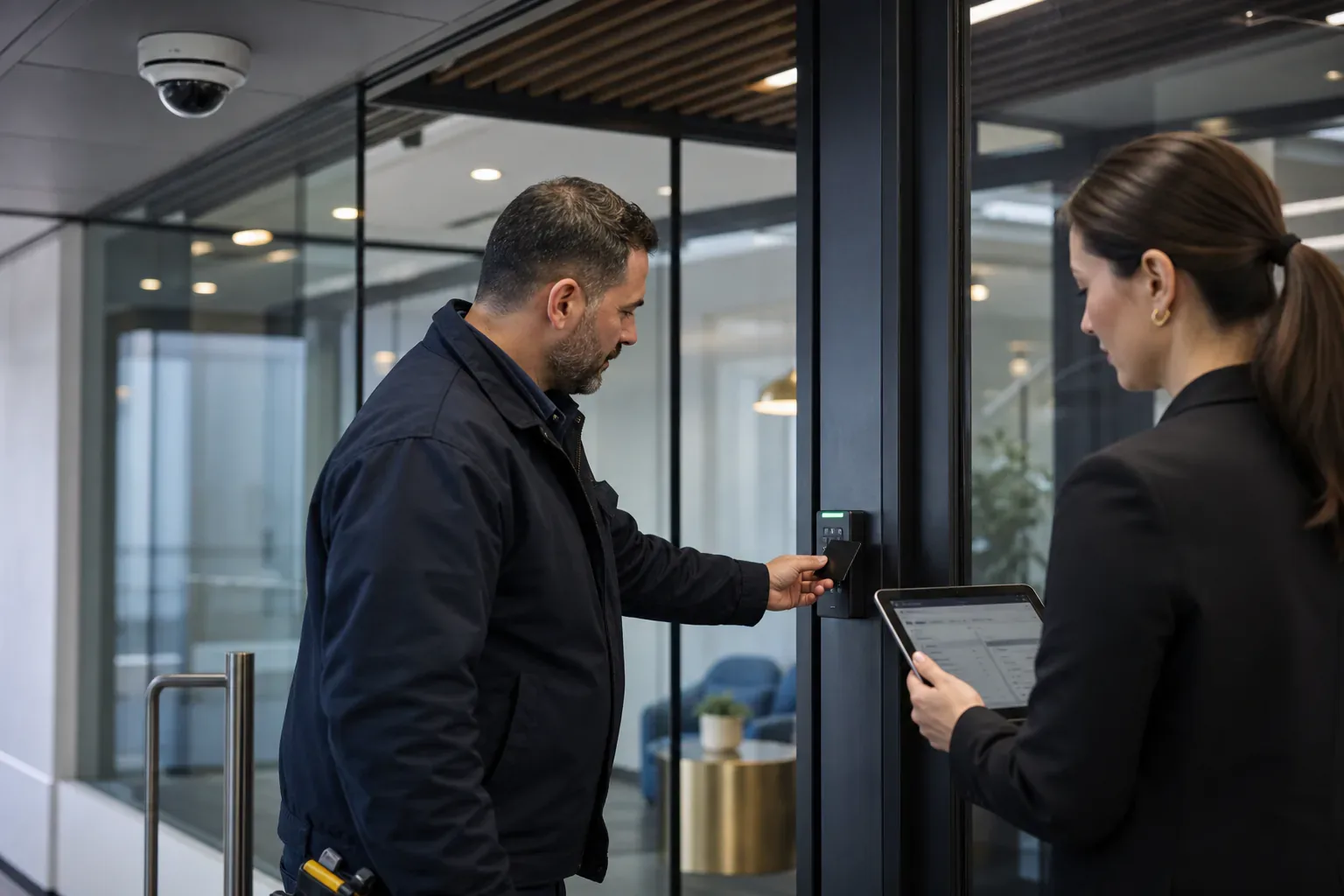
Security is a building system, not a gadget category — and in most commercial buildings it is the system with the least management attention. The cameras were installed years ago and nobody knows which ones still record. The access control database contains every employee who ever worked in the building, including the ones who left in 2019. The guard company files reports nobody reads. Levaru runs security for commercial buildings across Washington DC, Northern Virginia, and Maryland the way we run every other building system: as a managed program with an owner, a maintenance schedule, and documentation you can see in your client portal.
Access Control: The System Everyone Has and Nobody Manages
Electronic access control fails silently, through the database rather than the hardware. Every departed employee whose badge still works, every former tenant’s master credential, every door quietly set to unlock on a schedule nobody remembers approving — none of it announces itself until an incident forces the audit.
Our program treats the credential database as a living document: adds and deactivations tied to tenant move-ins and move-outs, quarterly audits reconciling active credentials against actual occupancy, and door schedule reviews so the building locks when it is supposed to. The hardware side rides the same maintenance discipline as everything else we touch — readers, electrified latches, closers, and request-to-exit devices get inspected and repaired as work orders, because a door that does not close is not a security system regardless of what is wired to it.
Most buildings do not get broken into. They get walked into, through a door that was propped, a latch that never caught, or a badge that should have died two years ago.
Cameras That Record, Coverage That Was Planned
Video systems earn their keep twice: deterrence daily, and evidence on the day something happens. Both fail if the system is unmanaged. Our camera program covers the basics that are skipped surprisingly often — verifying every camera records, keeping retention at the agreed window, cleaning domes and adjusting views that drifted, and replacing failures on a schedule instead of after the incident that needed the footage.
Coverage planning is where our platform earns its difference: because every Levaru building has a 3D walkthrough, camera and reader placement can be planned and reviewed against the actual geometry of lobbies, docks, garages, and blind corners — on screen, with the integrator, before anyone drills. The same digital twin documents where every device lives, which turns the next upgrade or insurance questionnaire from an archaeology project into a lookup.
Guard Services, Managed Honestly
Where a building warrants human presence — a staffed lobby, evening patrols, construction-phase coverage — the officers come from licensed security firms, as regional law requires, vetted and contracted under our supervision. What we add is the part guard contracts usually lack: written post orders specific to your building, incident reporting that lands in the portal rather than a binder, performance reviews against the contract, and the willingness to replace a vendor that has gone flat. A guard post is a significant recurring spend; it should be managed like one.
Lighting, Landscaping, and the Unfashionable Security Layers
Some of the highest-return security work does not look like security. Garage and exterior lighting kept actually lit — a maintenance discipline our electrical services crew owns — does more for after-hours safety than most camera additions. Hedges pruned below sightlines, dock areas kept clear, vacant suites checked on a schedule: these live in the routine building rounds, which is the advantage of security run inside an integrated facility management program instead of as a stand-alone vendor silo. After-hours alarm and incident calls route through the same 24/7 emergency response operation that answers for floods and outages, so there is always a number that picks up.
When Something Happens Anyway
No program reduces incidents to zero, so part of security is being ready to be useful afterward. That means incident reports written to a standard and filed in the portal the same day, camera footage pulled and preserved before retention windows eat it, door and credential logs exported while they still exist, and a factual timeline available for the police report, the insurance claim, or the tenant conversation. Buildings that handle the aftermath well tend to be the ones where the records were being kept all along — the incident report that references the access log, the camera clip, and the work order that fixed the latch is worth more than any of them alone. It is also, quietly, what keeps a single incident from becoming a lease-renewal problem.
Where to Start
Not with a hardware quote. We start with a security review of the building as it operates today: what is installed, what still works, who can open what, where the incidents and near-misses have actually occurred, and what the tenants’ leases promise them. The output is a prioritized plan — usually beginning with credential hygiene, door hardware, and lighting before any new equipment — with costs attached so decisions are financial rather than fearful.
If nobody can tell you today how many active credentials your building has, or whether the garage cameras recorded last night, that is a normal starting point. Request a proposal and we’ll begin with the audit.
FAQ
Security Services — common questions
Does Levaru provide security guards?
We manage guard services rather than self-performing them. Security officers in this region must work for licensed security companies — DCJS licensing in Virginia, with parallel regimes in DC and Maryland — so we vet and contract licensed guard firms, write the post orders, set the reporting standards, and supervise performance inside the same program as the rest of the building. You get guards who are actually managed, without adding another vendor relationship to your own plate.
What is the most common security gap in commercial buildings?
Not break-ins — doors. Propped stairwell and dock doors, access-control credentials that were never deactivated after employees left or tenants moved out, and failed door hardware that people work around instead of reporting. A building can have expensive cameras and still be effectively unlocked. The unglamorous disciplines — credential audits, door hardware maintenance, and someone actually walking the perimeter — close more risk than any single piece of equipment.
Who manages the access control system after it is installed?
In most buildings, functionally nobody — the integrator installed it, the property manager has a login, and the credential database has not been audited since move-in. We run access control as a living system: adds and removals tied to tenant move-ins and departures, quarterly credential audits against actual occupancy, door schedule reviews, and hardware maintenance so failed readers and latches become work orders instead of propped-open workarounds.
How much video retention do commercial buildings need?
Thirty days is the working baseline for most commercial properties — long enough that an incident discovered late still has footage, short enough to be affordable. The more important questions are coverage and function: are the entries, docks, garage, and elevator lobbies actually covered, and is every camera recording today? A camera that failed eight months ago and was never noticed is the most common finding in security reviews. Ours are checked on a maintenance schedule like any other building system.
How much does commercial building security cost?
Guard coverage is the dominant cost where it exists, priced per post-hour by the licensed guard firm; a single 24/7 post costs more per year than most buildings' entire electronic security budget. Electronic layers — access control, cameras, intrusion — carry maintenance and licensing costs that are modest by comparison. That is why we start with an assessment rather than a quote: the right mix of hardware, monitoring, and human presence depends on the building, its tenants, and its actual incident history, not on a package.
Next step
Tell us about your building. We'll show you what we'd do with it.
Curious how it works? See how our 3D walkthroughs work →