
Facility Management
Commercial Landscaping & Grounds Care in the DMV
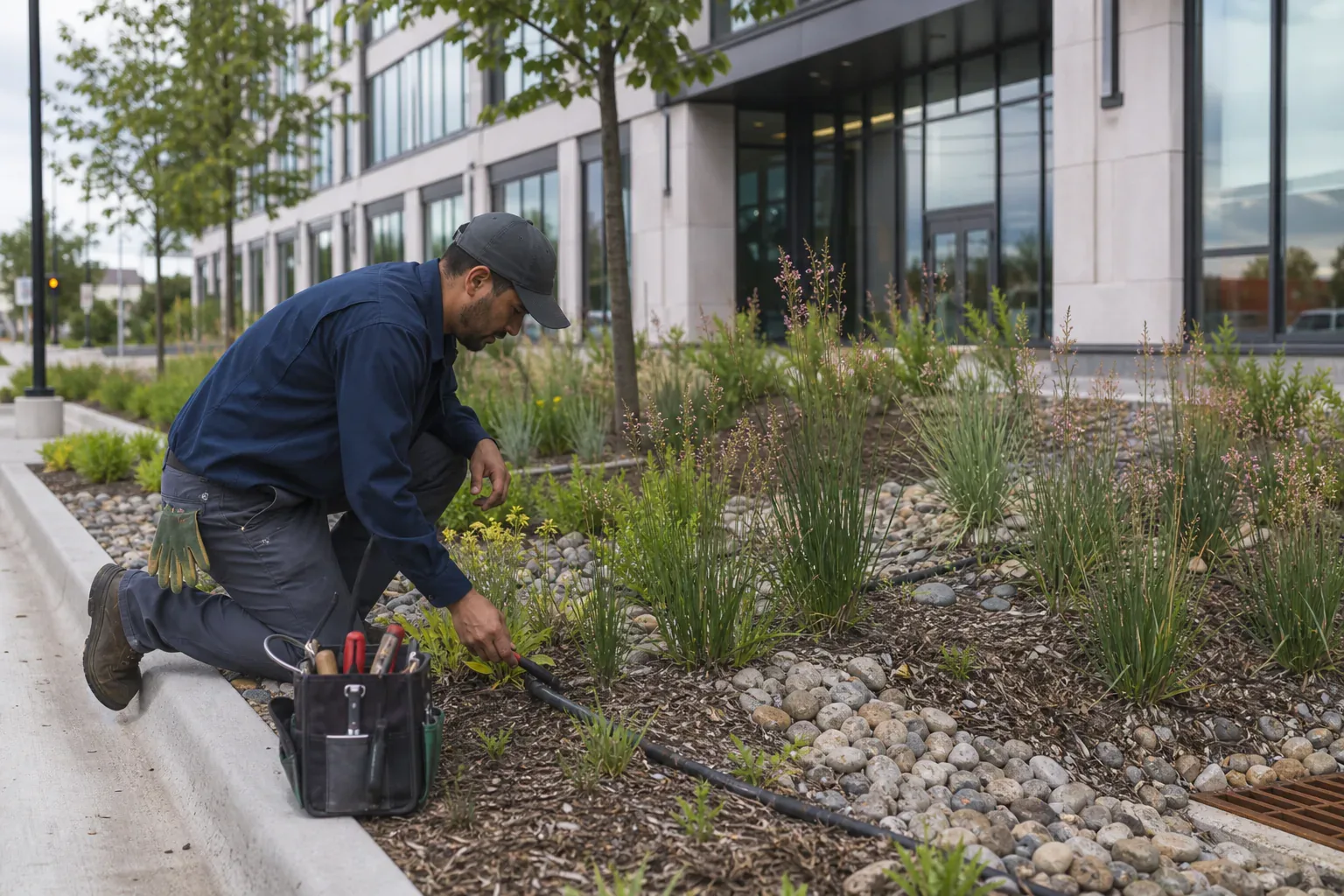
Grounds are the first thing every prospective tenant, lender, and visitor sees, and the last thing most building budgets take seriously. The gap shows: tired mulch, mower-scalped turf, a dead limb over visitor parking, and a bioretention bed that has become a weed exhibit. Levaru runs landscaping and grounds for commercial properties across Washington DC, Northern Virginia, and Maryland as part of an integrated facility management program — a year-round maintained system with an inspection cadence and photo documentation in your client portal, not a mowing subscription.
A Year on DMV Grounds
This region’s grounds calendar is genuinely four-season, and the contract has to match it:
- Spring — cleanup and bed edging, mulch, pre-emergent and turf feeding, irrigation startup with zone inspection, and a post-winter walk for salt damage, heaved pavers, and plow scars left by the snow season
- Summer — weekly mowing through the growing season, bed weeding on a cycle, pruning, irrigation monitoring through the hot stretch, and storm-response walks after the thunderstorms that take limbs down every July
- Fall — the leaf campaign (in oak-heavy Northern Virginia and Maryland office parks, a logistics operation in its own right), aeration and overseeding where turf earns it, final mow, and irrigation winterization before the first hard freeze
- Winter — dormant pruning, condition assessment while the structure of trees and shrubs is visible, and the handoff to snow removal — typically the same contract and the same accountable party, which is exactly how the transition weeks around a storm should work
Every visit closes with photos, so you can see what “weekly service” actually delivered without driving to the site.
The Liability Side of Grounds
Grounds are a safety surface before they are a beauty contest. Root-heaved sidewalk sections, hedges grown over sightlines at drive exits, groundcover swallowing a walkway edge, dead limbs over parked cars, and dark corners where shrubs overtook the site lighting — each is an incident report drafting itself. Our site inspections treat these as findings that become work orders, the same discipline we apply inside the building, and the documented trail matters: after an incident, the difference between negligence and misfortune is often whether anyone can show the hazard was being looked for. Sightline and lighting items feed the same program our security reviews draw on.
Nobody budgets for the sidewalk trip claim or the limb through a windshield. The annual tree review and the quarterly site walk are what those claims cost when they’re prevented instead.
Stormwater Facilities Are Infrastructure, Not Landscaping
The detention pond, the bioretention islands in the parking lot, the underground vault under the back drive — on most commercial sites in Maryland and Virginia, these carry recorded maintenance obligations, and county inspection programs enforce them. They fail slowly and expensively: sediment accumulates, outlet structures clog, plantings die, and by the time the inspection letter arrives the fix is reconstruction rather than upkeep.
We put stormwater facilities on the same footing as any regulated building system — inventoried at onboarding, inspected on a calendar, maintained routinely (sediment and debris removal, outlet clearing, vegetation management), with records kept for the county’s inspector alongside the building’s other compliance documentation. The irrigation system’s backflow assembly rides the same compliance calendar.
Grounds Are a Leasing Asset. Spend Like It
Every tour starts in the parking lot, and brokers will tell you plainly: prospects decide more from the approach than from the mechanical room. That is why we treat enhancements as leasing investments with proposals to match — entry and monument bed refreshes, seasonal color rotations at the main entrance, screening plantings where the dumpster corral greets visitors, each priced with photos and options rather than pitched as an open-ended “beautification” line. The photo record in the portal serves double duty here: it documents service quality month to month, and when a listing or refinance needs the property photographed, the grounds are already in shape instead of six weeks away from it. Owners preparing a building for lease-up or disposition get a grounds plan sequenced to the marketing calendar, not the mowing calendar.
One Accountable Party, Twelve Months a Year
The typical alternative is a mowing vendor, a separate tree company, an irrigation contractor, a snow contractor, and no one responsible for the property as a whole — with every gap between them owned, by default, by you. Under our program the grounds have a single owner across all four seasons. Our crews and managed specialty partners (tree work above pruning height, irrigation repairs) run inside one work-order system, enhancement proposals come with costs and photos attached, and the winter handoff to snow operations happens inside one company instead of between two contracts.
If your grounds spend is spread across four vendors and nobody has walked the stormwater pond in years, that is a normal starting point. Request a proposal and we’ll walk the site — turf, trees, irrigation, and the pond — and quote from what’s actually growing there.
FAQ
Landscaping & Grounds — common questions
What does commercial grounds maintenance include?
The visible layer: mowing and edging on a weekly growing-season cycle, bed maintenance and seasonal mulch, shrub and small-tree pruning, seasonal color plantings, irrigation operation, fall leaf removal, and lot and walkway policing for litter and debris. The less visible layer matters as much: drainage and erosion monitoring, tree condition assessment, stormwater facility upkeep, and the site inspections that catch trip hazards and dead limbs before an incident report does.
How is commercial landscaping priced?
Almost always as an annual contract billed monthly, sized from the maintained acreage, bed and turf areas, tree count, irrigation zones, and visit frequency. The seasonal workload varies enormously — spring cleanup and mulch, weekly summer mowing, fall leaf runs — but the flat monthly bill smooths it. Enhancements like new plantings, tree work above pruning height, and irrigation repairs are quoted separately. The commonest pricing mistake is comparing bids without comparing scopes: a low bid that mows less often and skips bed weeding costs more in curb appeal than it saves.
Who is responsible for stormwater pond and bioretention maintenance?
The property owner, in writing. Most commercial sites in Maryland and Virginia developed in recent decades carry recorded maintenance agreements for their stormwater facilities — ponds, bioretention beds, underground vaults — and county inspectors do come around. Failed inspections bring repair orders measured in real money, and a neglected bioretention bed can quietly become a five-figure reconstruction. We treat these facilities as infrastructure with an inspection calendar, not as landscaping that happens to hold water.
Does irrigation need any testing or compliance work?
Yes, two kinds. The backflow preventer on the irrigation supply requires annual certified testing filed with the water utility, the same as the building's other assemblies. And the system itself should get a spring startup with zone-by-zone inspection and a fall winterization blowout — skipped winterizations are the leading cause of cracked lines and the mystery wet spots that follow in May. Mid-season checks catch the broken heads that otherwise water the sidewalk all summer on your water bill.
How often should commercial trees be inspected?
A documented condition review once a year, plus a walk after major storms. Trees are the grounds feature with genuine liability attached: dead limbs over parking, root heave lifting sidewalks, and declining trees near buildings all read as negligence claims once something falls. An annual review sorts the population into monitor, prune, and remove — and produces the paper trail showing the owner acted on what was known.
Next step
Tell us about your building. We'll show you what we'd do with it.
Curious how it works? See how our 3D walkthroughs work →