
Projects & Construction
Commercial Construction Management in the DMV
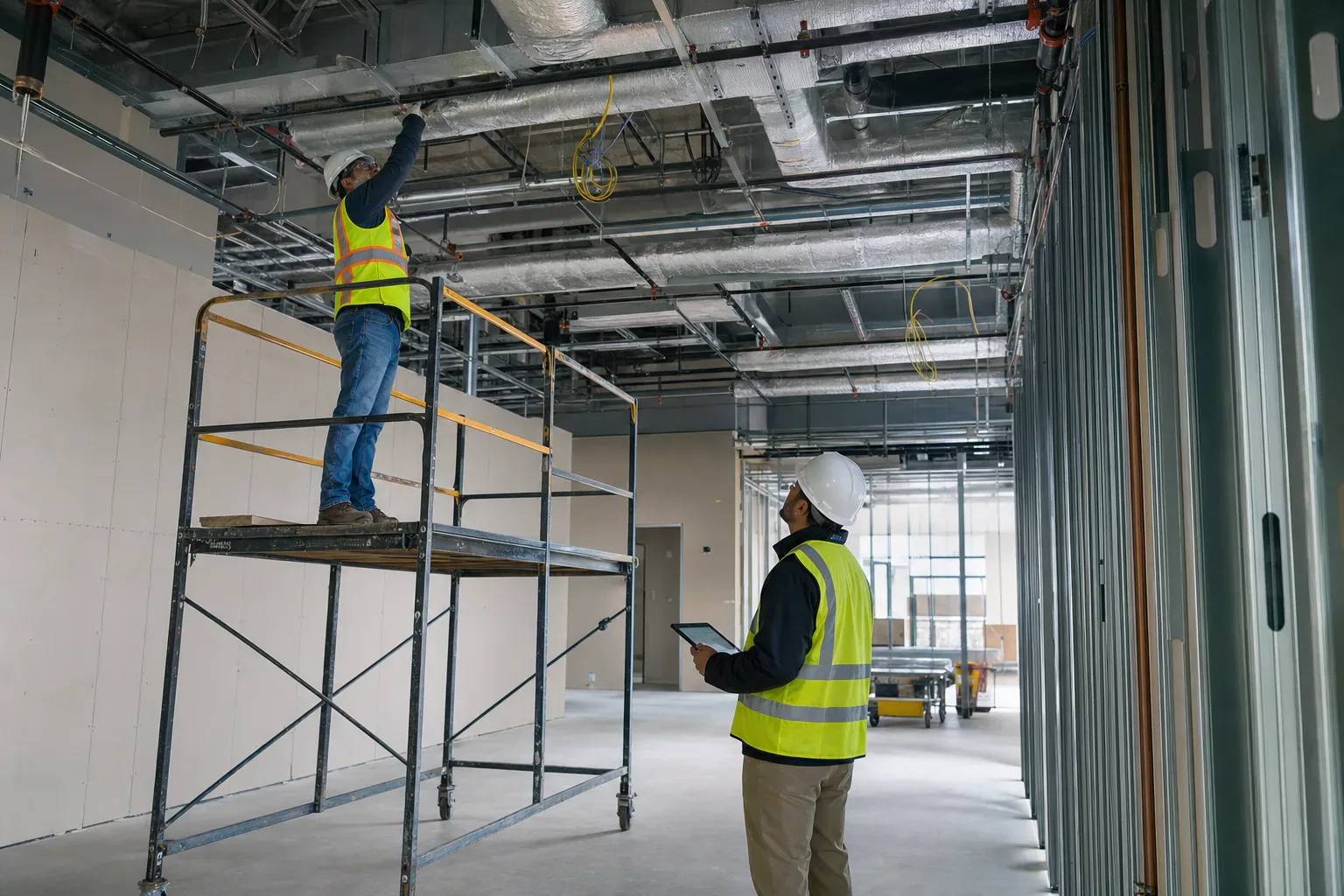
Construction management is the field-level discipline of running a commercial construction project once it is under way: verifying quality against the drawings, tracking submittals, enforcing the schedule, and paying only for work actually in place. Levaru provides owner-side construction management across the DMV from our headquarters in Alexandria, Virginia, as part of our projects and construction practice. We stand on your side of the table, in the field, every step of the build.
If project management is the broad owner’s-representative role that starts before design, construction management is the sharp end of it: the boots-on-the-site work that happens between mobilization and closeout, where a project is either built right or quietly built wrong.
Construction Management as Agent, Not at Risk
The first thing to settle is which kind of construction manager you are hiring, because the two are opposites. A construction manager at risk holds the trade contracts and guarantees the price, which makes them, functionally, the builder. A construction manager as agent holds no contracts, takes no markup on the work, and exists only to advise and protect the owner.
Levaru works as agent. We have no financial interest in the construction contract, which is exactly what lets us question a contractor’s number without a conflict sitting behind the question. When we push back on a change order or reject a pay application, it is because the work does not support it, not because our own margin depends on the answer.
The lowest number on a bid cover page is not the lowest cost. Construction management is the work of making sure the price you were promised is the price you actually pay.
What We Verify in the Field
The daily job is verification, and it is unglamorous by design. We walk the site against the drawings and specifications and document what we see with dated photos, so the record of the project is built as the project is, not reconstructed later from memory.
The specific controls are the ones that get skipped on troubled jobs:
- Quality against the documents. Work is checked against the drawings and specs, not against the contractor’s assurance that it matches. Deficiencies get logged and tracked to correction, not mentioned once and forgotten.
- RFIs and submittals. We keep the question-and-answer pipeline moving, because a stalled submittal on a long-lead item becomes a schedule delay six weeks later that nobody connects back to its cause.
- Inspections. We confirm the required jurisdictional inspections happen on schedule, because a missed inspection can mean opening a wall that was already closed.
- Pay-application review. Before your money moves, every payment is checked against work actually in place. Paying ahead of progress is how owners end up funding a project a contractor has already walked away from.
Change Orders Get the Same Three Questions
Every proposed change is tested the same way: is it truly outside the contracted scope, is the pricing supported by real labor and material backup, and what does it do to the schedule? Legitimate changes get processed quickly with your written approval, because slow-walking a real change is its own kind of cost. Padding gets returned with the questions attached.
Most change orders are born in scope gaps, which is why the cheapest change-order control happens before construction, in a scope document with no gaps to exploit. But once the job is running, disciplined change management is what keeps the final number close to the awarded one.
Building While the Neighbors Work
Most commercial construction in the DMV happens in occupied buildings, which makes logistics half the job. Demolition, coring, and loud work move to evenings and weekends. Dust is managed with sealed containment and negative air, because one afternoon of drywall dust in a neighboring suite costs more goodwill than a month of quiet progress. Corridors get protected, materials move on scheduled freight runs, and neighboring tenants get notice before the loud nights, not complaints after them.
Those rules differ by building and by jurisdiction, and a contractor who did not price them will either bust the budget or break them. We put them in the bid documents up front and hold the contractor to them in the field.
Documented as It Is Built, Not After
Construction disputes are usually memory disputes: what did the space look like before demolition, was the conduit installed before the wall closed, what is actually above that ceiling grid. We answer those with a camera. Projects are captured in 360° photo documentation at three points, existing conditions, in-wall and above-ceiling before they close, and finished conditions, all tied to the floor plan and viewable in a browser.
The mid-construction capture is the one owners thank us for years later, when a renovation or a leak investigation needs to know what is inside a wall without opening it. The final capture becomes the as-built record your operations team starts from.
Building something in Alexandria, Arlington, Washington DC, Bethesda, or Baltimore? Request a proposal and we will put an owner’s advocate in the field before the first trade mobilizes.
FAQ
Construction Management — common questions
What does a construction manager do that a general contractor does not?
A general contractor builds the project and earns money on the construction itself. An owner-side construction manager works only for you: verifying that work meets the drawings, tracking RFIs and submittals, enforcing the schedule, and reviewing pay applications before your money moves. The GC is accountable for means, methods, and safety; the construction manager is accountable for protecting the owner's quality, budget, and schedule against them. The two roles check each other, which is the point.
What is construction management as agent versus at risk?
Construction management at risk means the CM holds the trade contracts and guarantees a price, effectively acting as the builder. Construction management as agent means the CM is the owner's advisor and advocate, holding no trade contracts and taking no markup on the work. Levaru works as agent. We have no financial stake in the construction contract, so when we question a contractor's pricing or a change order, there is no conflict behind the question.
What does a construction manager check during the build?
The daily work is verification. We walk the site against the drawings and specifications, log observations with photos, track RFIs and submittals so nothing stalls the schedule, and confirm inspections happen on time. Before any payment, we review the pay application against work actually in place, not against the schedule of values on paper. Change orders get tested for scope, pricing backup, and schedule impact before they are approved.
Can construction management work on an occupied commercial building?
Yes, and most commercial construction happens in buildings that stay open. That changes how the work is managed: after-hours windows for loud or dusty work, negative-air containment, protected paths of travel, elevator and loading-dock scheduling, and advance notice to neighboring tenants. We make those requirements part of the bid documents so contractors price them, then hold the contractor to them in the field. In an occupied building, the neighbors judge the project as much as the punch list does.
What areas does Levaru provide construction management in?
Levaru provides construction management across the DMV from its Alexandria, Virginia headquarters, including Alexandria, Arlington, Fairfax, Tysons, Washington DC, Bethesda, Rockville, and Baltimore, with service throughout Northern Virginia, the District, and Maryland. Being local matters in the field, because inspections, permitting, and building rules differ by jurisdiction and quality problems get solved by someone standing in the room, not on a phone.
Next step
Tell us about your building. We'll show you what we'd do with it.
Curious how it works? See how our 3D walkthroughs work →