
Facility Management
Commercial Janitorial Services in the DMV
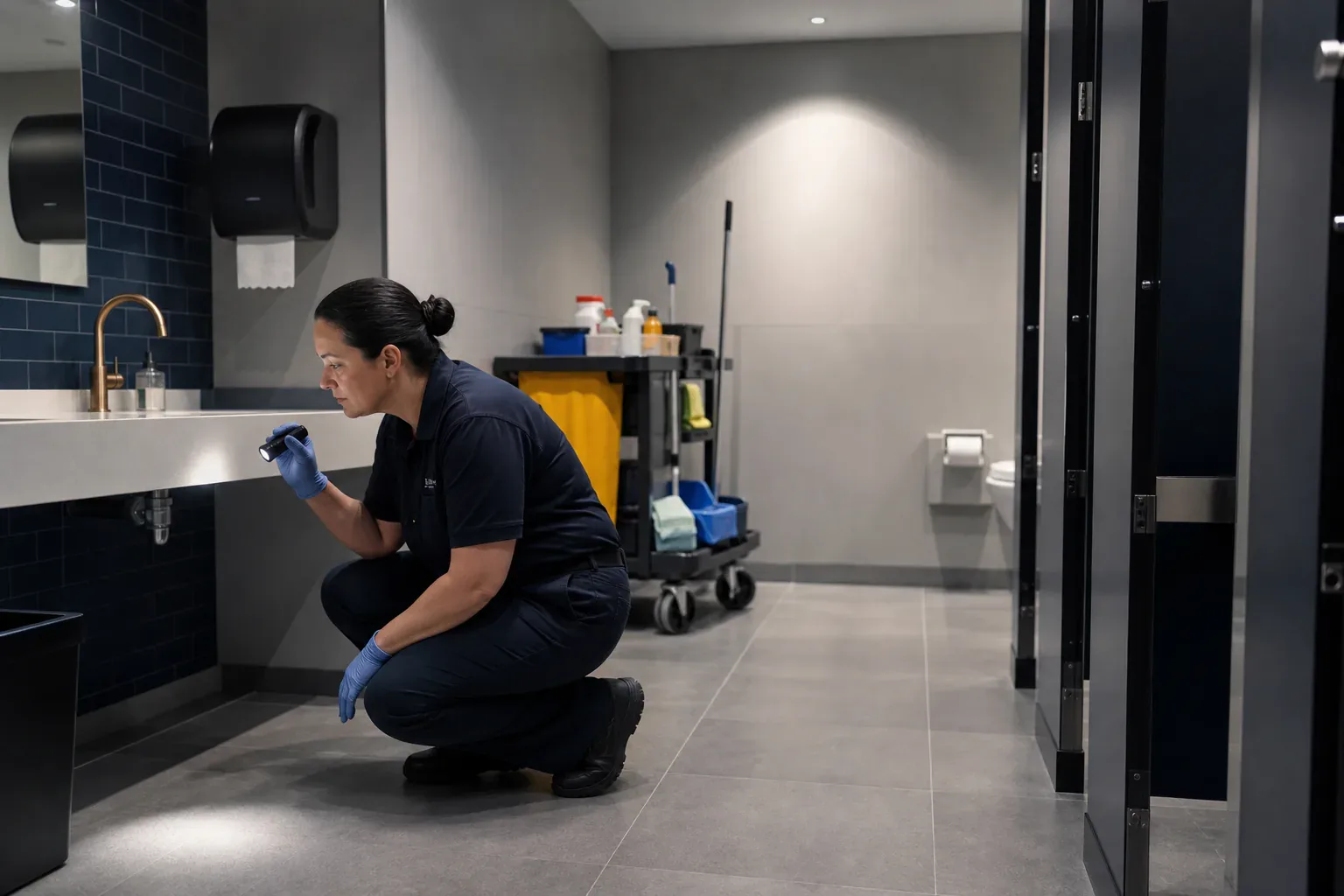
Commercial janitorial services are where building owners have the least visibility and the most recurring spend. You pay every month, the work happens at night when nobody is watching, and the only feedback loop is tenant complaints. Levaru runs janitorial programs for commercial buildings across Northern Virginia, Washington DC, and Maryland with a different model: written scopes by area type, trained day porter and night crews, and QA inspections you can see, with photos, in your client portal.
Cleaning is also not cosmetic. It is the soft service tenants judge your building by every single day, and it shows up directly in renewal conversations.
Day Porter vs. Night Crew: Two Jobs, Not One
The night crew does production cleaning after the building empties: trash and recycling, vacuuming, restroom sanitation, mopping, break rooms, and the periodic floor work. Their output is measured in completed scope.
The day porter’s job is different: keep the building presentable while it is full of people. Lobby glass and floors touched up through the day, restrooms checked and restocked on a route, spills handled in minutes instead of overnight, loading dock and common areas policed, conference rooms reset. In a busy office or medical building, restrooms cleaned at 11 p.m. do not survive until closing without midday attention.
Smaller or lower-traffic buildings sometimes run night-only service. Multi-tenant Class A space in Arlington or Tysons almost always needs both. We will tell you which your building actually needs based on traffic, not sell you hours.
Scope of Work by Area, Not by Slogan
A janitorial contract is only as good as its scope matrix. Ours defines tasks and frequencies per area type, because a lobby and a parking garage are not the same job:
- Lobbies and entrances: daily floor care matched to the surface (walk-off mats, stone, polished concrete), glass, elevator cabs and tracks, high-touch surfaces. This is the first fifteen seconds of every visitor’s impression.
- Restrooms: the highest-complaint area in any building. Fixtures, partitions, floors, and touchpoints disinfected on defined frequency; dispensers filled; drains maintained so the “what’s that smell” call never happens.
- Tenant suites: trash, vacuuming, and dusting on the contracted schedule, with suite-specific instructions logged so the crew doesn’t rely on memory.
- Break rooms and kitchens: counters, sinks, appliance exteriors, and floors, plus the degreasing frequency that keeps pests uninterested. Cleaning and pest pressure are directly linked.
- Stairwells, corridors, freight areas: the spaces nobody scopes and everybody notices during a fire drill.
- Parking garages: scheduled sweeping, stain treatment, elevator lobbies, and trash policing. A dark, dirty garage undoes an immaculate lobby.
Periodic work is scheduled, not improvised: carpet extraction, hard-floor scrub and recoat, high dusting, and exterior glass on a published calendar you can see in advance.
Consumables, Handled
Paper, soap, liners, and sanitizer sound trivial until a full-building tenant emails about an empty dispenser at 2 p.m. We manage consumables as part of the program: standardized products across the building, usage tracked so ordering is ahead of demand, and stock counted during porter routes. Consolidated purchasing generally beats retail buying, and it eliminates the single most common restroom complaint, which is an empty dispenser, not a dirty one.
Green Cleaning as Standard Practice
Our default program uses third-party certified chemistry such as Green Seal certified product lines, dilution control so crews aren’t free-pouring concentrate, microfiber tools, and HEPA-filtration vacuums. This is practical, not decorative: milder chemistry preserves floor finishes and fixtures, proper dilution cuts chemical spend, and HEPA vacuums actually remove dust instead of blowing it back into the return air. For buildings pursuing sustainability goals, the janitorial spec plugs into our broader energy and sustainability work.
How Do You Know the Cleaning Actually Happened?
You inspect it, score it, and photograph it. Every Levaru janitorial account gets scheduled QA inspections scored against the written scope, area by area. Deficiencies are logged as work orders with photos and a correction deadline, and the follow-up inspection confirms the fix.
All of it lives in the client portal: inspection scores, photos, trends over time, and open deficiencies. You can check your building’s cleaning quality from your phone instead of waiting for a tenant to tell you about it. That is the standard we apply across our whole facility management platform, and janitorial is where owners feel it fastest, because it converts the most invisible service in the building into the most documented one.
If a janitorial vendor cannot show you an inspection record, you do not have a quality program. You have an invoice and a hope.
Clean Buildings Keep Tenants
Tenants rarely cite janitorial in a renewal negotiation, but they absolutely act on it. Dirty restrooms, sticky elevator rails, and a shabby lobby read as “ownership doesn’t care,” and that impression walks into every lease conversation before the broker does. Turnover is brutally expensive: downtime, tenant improvement allowances, commissions, and legal. Against that, the delta between mediocre and excellent cleaning is small money.
This is why our janitorial and commercial property management teams work off the same building record. When a property manager is heading into a renewal, the cleaning quality history for that tenant’s floor is already documented.
Janitorial is the cheapest tenant-retention program a building has. It is also the first line item owners cut, and the first reason tenants start touring other buildings.
How Commercial Janitorial Services Are Priced
Commercial janitorial is typically quoted as a fixed monthly price built from a few real inputs:
- Frequency: five-nights-a-week versus three is the biggest lever.
- Density and traffic: a packed call center generates several times the workload of a half-occupied suite with the same square footage.
- Restroom count: restrooms consume a disproportionate share of labor per square foot.
- Flooring mix: stone, VCT, polished concrete, and carpet each carry different periodic-care costs.
- Day porter hours: priced as staffed hours on top of night service.
- Specialty areas: garages, medical spaces, labs, and exterior glass are scoped and priced separately.
Beware of bids priced dramatically below the pack; the money comes out of labor hours, and you will see it in the corners within ninety days.
We quote from a walkthrough, never from square footage alone. If you operate a building in Alexandria, Arlington, Fairfax, Tysons, DC, Bethesda, Rockville, or Baltimore, request a proposal and we will walk the property, write the scope matrix, and price the program from what your building actually needs.
FAQ
Janitorial Services — common questions
What is the difference between a day porter and a night cleaning crew?
A day porter works during business hours keeping the building presentable in real time: lobby touch-ups, restroom checks and restocking, spill response, and common-area policing. The night crew does the heavy production cleaning after tenants leave: vacuuming, trash, restroom sanitation, mopping, and floor care. Most multi-tenant buildings need both, because a building cleaned perfectly at midnight can still look neglected by 2 p.m.
How is commercial janitorial service priced?
Usually as a fixed monthly fee derived from cleanable square footage, service frequency, and scope. The real drivers are days of service per week, building density and traffic, restroom count, flooring types, and specialty work like garage sweeping or exterior glass. Day porter coverage is priced by hours. Periodic work such as carpet extraction and floor refinishing is either built into the monthly fee or quoted per event.
What should be included in a janitorial scope of work?
A real scope lists each area type separately with tasks and frequencies: lobbies, restrooms, tenant suites, break rooms, elevators, stairwells, and garages each get their own matrix. It should also state consumables responsibility, day porter hours, periodic work schedules for carpet and hard floors, and how quality is inspected and reported. A one-line scope that says clean five nights weekly is how disputes start.
Who supplies restroom paper, soap, and trash liners?
Either party can, but it should be explicit in the contract. Levaru typically manages consumables for clients: we standardize products, track usage by building, and keep dispensers filled so restrooms never run out mid-day. Consolidated purchasing usually costs less than tenants or engineers buying retail, and it removes the most common source of restroom complaints, which is an empty dispenser rather than a dirty fixture.
Do you use green cleaning products?
Yes. Our standard program uses third-party certified chemicals such as Green Seal certified lines, microfiber systems that clean better with less chemical, and HEPA-filtration vacuums that improve indoor air quality instead of redistributing dust. Green cleaning is a practical choice as much as an environmental one: milder chemistry is easier on floor finishes, fixtures, and the people working in the building overnight.
How do you verify the cleaning actually happened?
Through scheduled QA inspections scored against the written scope, with photos logged in the client portal. Deficiencies become work orders with a correction deadline instead of a verbal promise. You can open the portal and see inspection scores, photos, and trends for your building at any time, which replaces the usual model of finding out about quality problems from a tenant complaint email.
Next step
Tell us about your building. We'll show you what we'd do with it.
Curious how it works? See how our 3D walkthroughs work →