
Industry
Facility & Property Management for Office Buildings
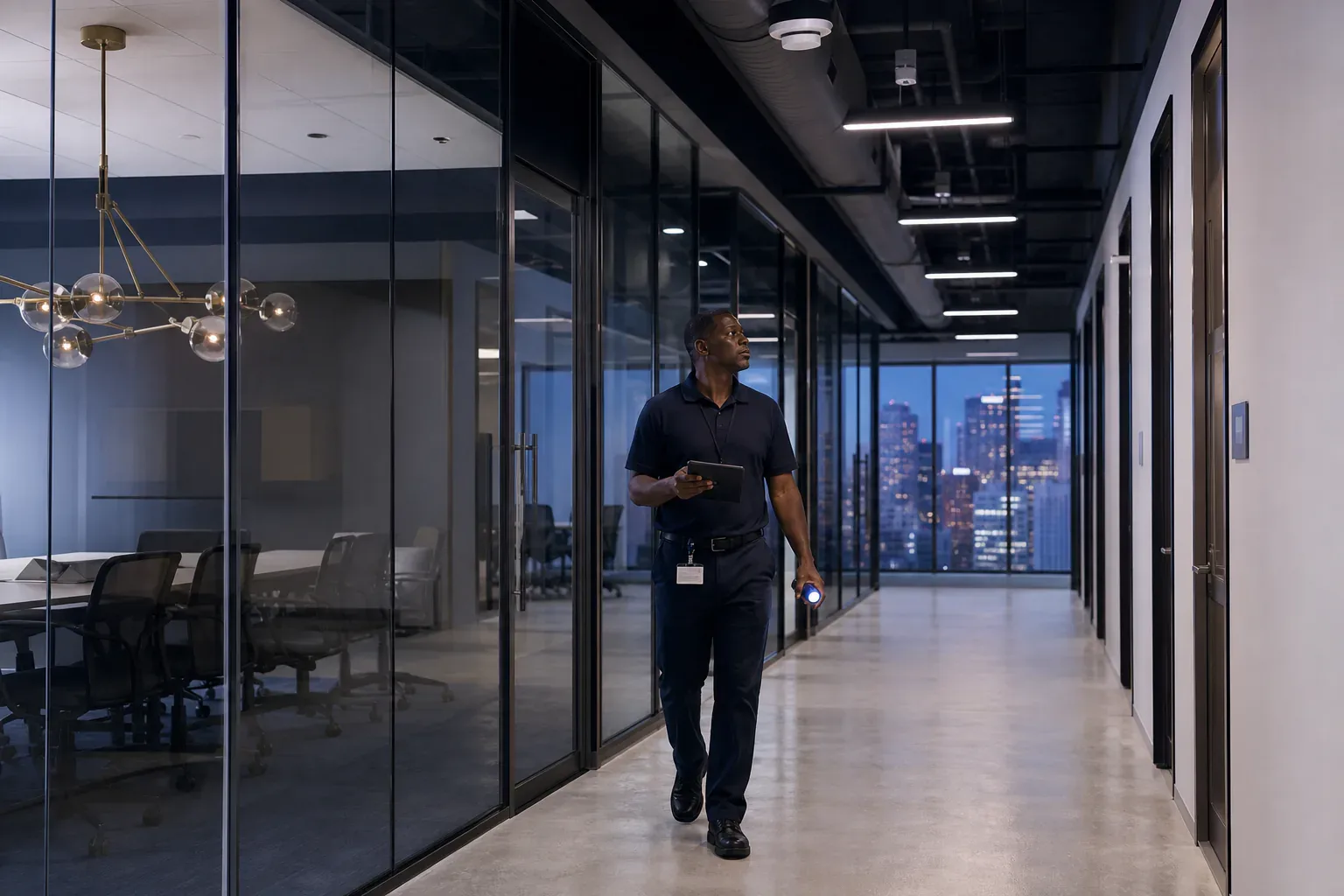
You can tell how an office building is run within thirty seconds of walking in. The lobby glass, the elevator wait, the restroom on your floor: tenants read those signals every day, and so do the prospects your leasing team walks through. Levaru provides office building facility management across the DMV, from Class A space in Tysons and Washington DC to the Class B and C stock that makes up most of Alexandria, Arlington, Bethesda, and Baltimore.
We are a facility management and commercial real estate firm headquartered in Alexandria, Virginia. We run the daily work: HVAC, electrical, plumbing, janitorial, grounds, pest, security coordination, and 24/7 emergency response, all under a facility management program built around preventive maintenance instead of breakdown response.
Office building facility management that tenants actually notice
Tenants do not grade you on your org chart. They grade you on whether the restroom was clean this morning, whether suite 410 hit 74 degrees again at 2 p.m., and whether the freight elevator was down on move-in day.
So that is where we put the effort. Lobby and common-area standards are written down, walked weekly, and photo-documented. Comfort calls get a response the same day, with the fix and the cause logged against the specific piece of equipment. Elevator service contracts get managed, not just filed: we track entrapments, callbacks, and downtime by car, because “the elevator is always broken” is a reputation you cannot lease against.
Janitorial is your number one complaint driver
Ask any building manager where tenant complaints come from and cleaning tops the list. Not roof leaks, not chillers. Trash not pulled, restrooms that slip on Fridays, carpet that never quite looks vacuumed.
Our janitorial service runs on inspection scoring, not assumption. Day porters and night crews work from a written scope by area, supervisors score against it, and recurring misses show up in the data before they show up in a tenant’s renewal negotiation.
In an office building, janitorial quality is judged in the restroom and the lobby. If those two pass inspection every single day, tenants forgive a lot. If they slip, nothing else you spend money on gets noticed.
Comfort calls, after-hours HVAC, and the bill
Temperature complaints are the second-biggest friction point in office buildings, and they are usually a maintenance problem wearing a thermostat costume: fouled coils, failed actuators, VAV boxes nobody has balanced since the last buildout. Our HVAC maintenance program works the equipment on a schedule so comfort calls trend down instead of repeating.
After-hours HVAC is its own sore spot. Tenants working late want air; owners do not want to condition ten floors for one law firm. We enforce the schedule the lease already defines, log actual after-hours run time, and bill it back with documentation both sides can see. Disputes mostly disappear when the record is not an estimate.
What drives office tenants to leave at renewal?
Accumulated service friction, more often than rent. A tenant who has spent the lease term re-reporting the same temperature problem, walking past the same stained ceiling tile, and chasing the same unanswered work order has usually decided to leave long before the renewal notice goes out.
Retention work is therefore operational work. Close work orders with photos so tenants see the fix, not just a status change. Communicate outages before they happen. Fix the small visible things fast, because tenants extrapolate from them. Every Levaru client gets a portal where tenant requests, photo-documented work orders, and building notices live in one place, which turns “did anyone look at this?” into a link.
Class A, B, and C buildings fail in different ways
Class A buildings fail on expectations: the standard is high, the tenants pay for it, and a scuffed elevator cab or a slow lobby turnstile reads as decline. The job there is consistency and polish, every day.
Class B and C buildings fail on deferred maintenance. Original equipment past its service life, patch-on-patch roofs, restrooms that date the building the moment a prospect sees them. In a hybrid-work market where tenants can choose newer space, older stock has to compete on being well-run and honestly priced. We help owners sequence that: a preventive maintenance plan that stretches remaining equipment life, then targeted upgrades, restrooms, lighting, lobby, spectrum-priced against the leasing plan rather than done all at once. Owners who want the full picture, operations plus financials plus leasing strategy, run it through our commercial property management service.
Every floor documented on our platform
Every building we take on gets documented on Levaru’s technology platform: QR-coded asset tags on the equipment, photo-verified work orders, a preventive maintenance calendar built from the actual assets on site, 360-degree photo documentation, and a browser-based 3D walkthrough of each floor with an interactive floor plan.
For an office owner that means you can open a browser and walk your own mechanical rooms, check what was done on any work order with the photos to prove it, and hand a lender or buyer a documented building instead of a binder of guesses.
If you own or operate office space in Virginia, DC, or Maryland, request a proposal and we will walk the building with you first. The walkthrough is where the real scope always shows up.
FAQ
Office Buildings — common questions
What does office building facility management include?
Day-to-day operation of the building systems and common areas: HVAC operation and maintenance, electrical and plumbing repairs, janitorial, grounds and snow, pest control, security coordination, preventive maintenance scheduling, and 24/7 emergency response. Levaru also documents every asset and work order on its own platform, so the owner can see photo-verified proof of what was done, when, and by whom.
How do you handle after-hours HVAC requests from tenants?
We set the schedule in the lease terms you already have, meter or log actual after-hours run time, and bill it back with documentation the tenant can see. The usual fight starts when tenants are billed from estimates nobody can verify. Our work orders and equipment logs give both sides the same record, which is what keeps the relationship civil.
Can you take over a building from an existing management company?
Yes. Transitions start with a full walkthrough where we tag assets with QR codes, capture 360-degree photo documentation and a browser-based 3D walkthrough of each floor, and build the preventive maintenance calendar from the actual equipment on site rather than an inherited spreadsheet. Vendors and open work orders carry over so tenants see no gap in service.
Do you work with older Class B and C office buildings?
Yes, and much of our DMV work is exactly that stock. Older buildings need a different plan: honest assessment of remaining equipment life, preventive maintenance that stretches capital, and a realistic sequence of upgrades tied to leasing goals. We manage the daily operation and can run the improvement projects under the same roof.
Which areas do you serve?
Virginia, Washington DC, and Maryland, from our headquarters in Alexandria. Primary coverage includes Alexandria, Arlington, Fairfax, Tysons, Washington DC, Bethesda, Rockville, and Baltimore, with service across the broader DMV. Call +1 (703) 646-8300 or email info@levaru.co to confirm coverage for a specific property.
Next step
Tell us about your building. We'll show you what we'd do with it.
Curious how it works? See how our 3D walkthroughs work →