
White paper
The Closure Note: A Facility Manager's Framework for Capturing the Diagnosis, the Fix and the Exception Before the Technician Leaves the Room
Nikolai Hanov
Published by Levaru
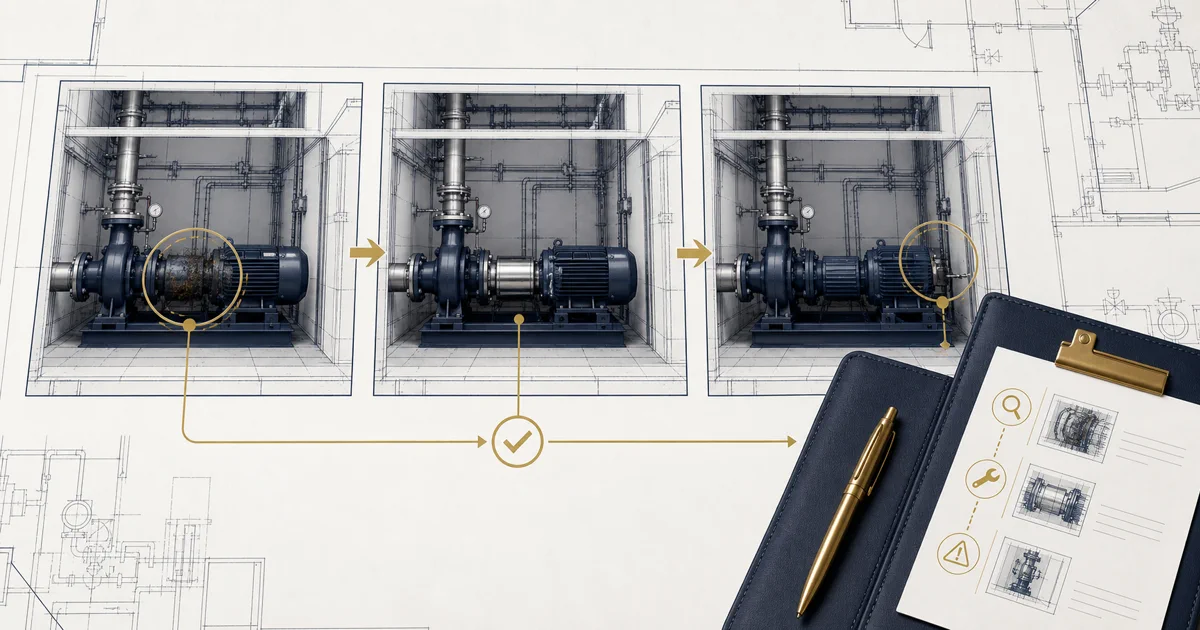
Full paper
The summary below covers the paper's key findings; the full text, methodology and figures are in the PDF.
Download the full white paper (PDF)The paper opens at 6:40 on a February evening, as a technician closes out the fault that has intermittently tripped a penthouse air handler for three weeks. The diagnosis was earned the hard way — two false starts chasing the freeze-stat, a morning spent watching the unit through its warm-up cycle, and finally the observation that the outside-air damper linkage was binding at a third of its travel, starving the coil just long enough on cold starts for the safety to catch. The fix took forty minutes. The understanding behind it took eleven days. The work order that records both closes with a status of Completed and a note that reads, in full: “Reset unit. Done.” Nothing in that transaction involves anyone failing at their job: the technician was hired to restore the equipment, the equipment is restored, and the system of record has been fed exactly what it demands — a status, a timestamp, a labor line. But the diagnosis, the cause, the trick of the fix and the warning for the next cold snap existed, complete and fresh, in exactly one place: the mind of a person standing at the asset with a text field open. The field closed around one word, and the knowledge walked to the parking lot. “The most expensive sentence in facility management,” the paper’s standing epigram runs, “is ‘Done.’”
Multiply the transaction by an operation’s history and the shape emerges: a mid-sized portfolio’s CMMS holds tens of thousands of completed work orders — statuses immaculate, dates precise, text fields empty or nearly so — an archive that can prove work happened without being able to say what the work knew. Levaru’s earlier research called the missing layer located knowledge: real, operational, tied to specific places and assets, and almost never written down, because for as long as its holder is one radio call away it never needs to be. The work order, Hanov argues, is where located knowledge surfaces on a schedule — every fault summons it — and the closure field is the one moment in ordinary operations when the problem, the solution and the person who understands both stand in the same place at the same time. The loss is discovered by three readers, each arriving too late: the next technician, who inherits the recurring fault and eleven days of someone else’s diagnosis to repeat; the successor, for whom the archive should have been a syllabus and is instead a list of dates; and the external reader — the incoming contractor at a changeover, the warranty adjuster, the insurer, the auditor — for whom an empty record is at best a lost argument and at worst a finding. The remedy the paper proposes is neither a platform nor a project but a discipline, operated at the point where the knowledge already surfaces.
What a closure note is — and is not
The definition is precise: a closure note captures, in a structured minimum, what was found, what caused it, what was done, what was learned and what should happen next — written at the point of work, filed against the asset in the system of record, and sufficient for a competent stranger facing the same fault to reach the same fix without asking anyone. Every clause is load-bearing. The anatomy scales with criticality — the failed lamp does not need five lines and the chiller does, and the difference is a documented judgment rather than a mood. “At the point of work” matters because the memory of a repair decays in hours: the batch of orders closed from a desk on Friday afternoon is, in the paper’s phrase, “a work of fiction with accurate timestamps.” The note must land where the next reader will look, in a system that survives its author — a superb note in a personal notebook or a phone’s photo roll fails the definition completely. And the “competent stranger” imports the test that anchors the series’ measurement of documentation generally, applied at the level of the single fix: the reader to write for is not the author in a month but a qualified outsider with no one to call. The discipline sits deliberately between two established responses — the status-only archive (the CMMS operated as a timesheet: cheap, universal, structurally amnesiac) and the documentation project (the SOP library or wiki mandate: systematic but parallel to the workflow, always deferrable and therefore usually deferred). Closure discipline rides the workflow that already exists: the order is already open, the technician is already at the asset, the knowledge is already in hand. Two boundaries complete the definition: the note records operating reality, not design intent — it will frequently record where the building has quietly diverged from the drawings, which is much of its value — and it is raw material for analysis, not a root-cause-analysis program.
Why now
Three published pressures — each cited from independent sources rather than generated by the paper — frame the moment. The first is that the archive’s authors are leaving: a study cited in IFMA’s Facility Management Journal found 31 percent of facility management employees older than 55 and eligible to retire between 2022 and 2037, and the University of Tennessee, Knoxville’s facilities organization — roughly 600 staff across more than 250 buildings — recorded 97 retirements between 2020 and 2025. Every departure converts a deferred question into a permanent one, and the work-order record is the largest single place the deferral has been accumulating. The second is the measured cost of asking: the Panopto/YouGov Workplace Knowledge and Productivity Report estimated that 42 percent of institutional knowledge is unique to the individual who holds it and put the friction cost at 5.3 hours per employee per week — consistent with McKinsey’s estimate that interaction workers spend roughly 19 percent of the workweek searching for information, and a 2023 Quickbase survey in which 53 percent of respondents chased information more than 10 hours a week. Every empty closure field converts a one-time writing cost of minutes into a recurring asking cost of hours, payable by whoever meets the fault next. The third is that the archive has acquired external readers: with Grand View Research valuing the global facility-management services market at approximately US$1.75 trillion in 2024 and outsourced delivery at 61.5 percent of revenue, the work-order archive is the principal artifact one organization hands another at every contract changeover; warranty claims, insurance recoveries and disputed handovers are decided on contemporaneous records; and a renewal case argued from documented failure history — against Gordian’s US$156 per gross square foot of deferred capital renewal on North American campuses — reads very differently to a CFO than one argued from anecdote.
The four instruments
The Re-Fix Test is the headline measure — the work-order-level sibling of the series’ Handoff Test. Where the Handoff Test asks whether a role survives its holder, the Re-Fix Test asks whether a fix survives its fixer: if this fault recurred tomorrow and the technician who resolved it were unreachable, could a competent stranger, reading only the work-order record, reach the same diagnosis and the same fix without re-deriving either? Each month a sample of recently closed corrective orders is judged against the record alone, with a deliberately binary verdict, optionally weighted by criticality — so a team whose passing notes are all lamp replacements scores as badly as it should. The test can be run live, and periodically must be: hand an outsider the fault description from a genuinely closed order, restrict them to the record, and watch where it fails them. Twenty minutes of observed struggle settles arguments that a month of self-assessment cannot.
The five-line anatomy is the discipline’s core artifact, teachable in a toolbox talk. FOUND records the symptom and the as-found state — the line that would have saved the eleven days. CAUSE records what actually failed, as distinct from what complained: the binding linkage, not the tripping safety — the line the failure code attaches to, and the one that turns three isolated events into one chronic asset. ACTION records what was done in enough detail to repeat. LEARNED is the line that separates an archive from a log — the exception, the quirk, the setting that looks wrong and is deliberately so (in the paper’s worked example, a freeze-stat set two degrees above spec after a 2019 coil repair, with the warning do not “correct” it). NEXT records watch items and follow-up work — the line that spawns the next work order instead of relying on someone’s memory. Dictated at the asset, the five lines take about ninety seconds; typed, about three minutes — and the paper counts those minutes without apology.
The Closure-Quality Audit samples 25 to 40 recently closed corrective orders a month, scored by a rotating pair of reviewers on two deliberately coarse axes. Recurrence likelihood asks whether the fault or its family will present again; record recoverability asks the Re-Fix question at order level. The resulting Recurrence–Recoverability Matrix gives every sampled order a standing instruction, and its red quadrant — high recurrence, low recoverability, the same equipment with three closures and no content — triggers the audit’s one intervention with a clock on it: an enrichment pass made while the fixing technician still remembers, because a red-quadrant order enriched in the same month costs minutes and the same order reconstructed next season costs a diagnosis. Findings feed exactly three places: the template library, the toolbox talk (where one good note is read aloud as recognition, not correction), and an enrichment backlog worked with the same weekly discipline as the maintenance backlog it resembles.
The capture-mechanisms menu is deliberately plural and vendor-neutral: voice-to-text dictation at the asset, photo-first closure with annotations, a five-prompt guided form, a small problem–cause–remedy code taxonomy in the reliability world’s manner (“twelve, not four hundred” — codes for counting, prose for knowing), per-asset-class templates, scribe pairing for veterans in their final years, and an escalation debrief for after-hours work. Two principles govern the matching: the record must land in a system that survives its author, and the mechanism chosen must be the one the holder will actually complete — the veteran who will never type a paragraph will narrate a flawless one while pointing at the equipment.
Where it pays back first
The recurring fault. Diagnosis is the expensive half of corrective work, and recurrence is the norm: faults arrive in families — the seasonal trip, the fleet-common component — and the family’s second visit is where the record either pays or doesn’t. A passing note collapses the second diagnosis to a reading, largest exactly where operations hurt most: after hours, when the responder is whoever is on call rather than whoever knows the unit. A working archive also ends the reassignment chain — the order that bounces between technicians until it finds the one person who has seen the fault before is an order searching for a record that should have existed — and the coding layer converts folklore into evidence: “that unit is trouble” becomes three cause-coded linkage failures in fourteen months, which is the sentence a capital request can actually cite.
The handoff and the new hire. An archive of honest closure notes is the only operational document that grows without a project, and the nearest thing a building has to a syllabus: chronic assets announce themselves, standing exceptions are written where the equipment is, and the veteran’s scarce mentoring time goes to judgment rather than to addresses. The Panopto study found new hires receiving roughly 2.5 months of formal training yet taking as long as six months to reach full productivity — and the slowest weeks of a first year are spent rediscovering, one work order at a time, exactly what the archive should already hold. The same machinery makes absence survivable: vacation coverage, the two-week resignation and the morning nobody scheduled are each the Re-Fix Test run live, without warning, on the whole portfolio at once.
The contract, the warranty and the audit. Notes written throughout a contract term in the owner’s system of record are knowledge the owner actually owns, whatever happens commercially — an argument for wiring closure standards into service agreements as a specified, sampled deliverable, extending to the operating phase the structured-handover logic the construction world encoded in COBie. Contemporaneous records decide warranty claims, insurance recoveries and disputed handovers — an archive of “Done.” concedes every such argument in advance — and regulators increasingly ask not whether maintenance was scheduled but whether its execution can be evidenced.
Crawl, walk, run — and five maturity levels
Implementation is staged. Crawl is a bounded 60–90-day pilot in one trade, team or building cluster: baseline first and quietly — a hundred recently closed orders scored against the Re-Fix Test before the standard is announced, because announcement contaminates the baseline; a one-page governance charter naming the owner and the evaluation firewall before the first toolbox talk; then the anatomy introduced with the crew’s edits — an hour in which the technicians rename the lines into their own words is not a courtesy but the difference between a form and a discipline (“a note standard the technicians amended is a standard the technicians will use”). The crew chooses one capture mechanism; the pilot ends with one live test and three numbers — the baseline, the movement, and the cost in minutes. Walk extends by asset criticality rather than alphabetically, at whatever pace the audit capacity can honestly sustain, with the cadence in writing, the twelve-code taxonomy pruned annually (its “Other” share the health gauge), and event triggers wired to where events first become visible: a chronic-asset flag, a resignation notice routing the leaver’s most-touched assets into a note review, a contract entering its final year starting acceptance sampling. Run is when the discipline’s verbs appear inside other documents’ sentences — vendor agreements, project closeout, the CMMS’s default templates, the KPI review, onboarding — and the practice passes its own test: documented, owned, able to survive its founder. A five-level maturity model locates teams before they plan a route — Status-only, Anecdotal, Standardized, Managed, Embedded — with most organizations honestly at Level 0 or 1, and no embarrassment in it: a Level 0 organization can be staffed entirely with excellent technicians, which is in fact the most common way to be Level 0. The move from 2 to 3 — from having announced a standard to operating one — is where most programs stall.
Baselines before benchmarks
The measurement chapter publishes no industry benchmark for any metric, declines to invent one, and regards any program justified by someone else’s numbers as unjustified. Six metrics, each capturable from the CMMS or a two-week sampling exercise: the Re-Fix score; the repeat-visit rate; note completeness against the appropriate tier; reassignment-chain length (“the archive’s failure to answer, measured in routing”); the ask rate — the share of sampled located-knowledge queries resolved by the most-consulted people rather than by the record, the program’s early-warning gauge, reported at team level only; and code hygiene, the share of failure codes landing in “Other.” Audit recency is reported beside every number the way a laboratory reports a calibration date. An illustrative cost model — every input a stated assumption, not a benchmark or promise — sketches a 20-technician team across 25 buildings closing roughly 6,000 orders a year: about 405–455 hours of year-one effort, of which the largest line is the capture tax itself — 250–300 hours of two-and-a-half to three minutes per closure, counted honestly — against on the order of 600 hours recovered, before counting a single avoided escalation, failed audit finding or conceded warranty claim. The point is the shape, not the outputs: bounded, predictable effort against open-ended, compounding exposure.
Governance and honest limits
Because the archive gathers information from and about individuals — including honest accounts of what a previous repair got wrong — governance is treated as a condition of getting true records, not a compliance appendix: “the day the closure note becomes a stopwatch is the last day it tells the truth.” Five rules constitute the minimum: a firewall — note content, quality and timestamps feed no performance evaluation, compensation decision or pace analysis, because the first exception ends the program’s supply of honesty permanently, and a sample full of empty notes is a finding about the standard, never about the people; just-culture handling of error narratives — the report of an error is not the confession of one, and an archive that punishes candor will be sanitized into uselessness within a quarter; attribution with dignity — author fields exist for reachability and credit, never for league tables; data-protection by design — notes and their photographs are personal data under regimes such as the GDPR, inheriting the series’ imagery rules; and honest workload accounting — the minutes are work, planned and credited, because a discipline funded by pretending its cost is zero will be paid for out of honesty instead.
The limitations chapter is candid: the note captures the locatable layer of a fix, not craft — diagnostic intuition is developed, not documented, and any program promising to bottle the veteran is overpromising by roughly the amount that matters most. The archive is evidence, not truth; scoring is structured judgment, not measurement; the three-minute tax is real and permanent; taxonomies ossify; and the discipline scales with criticality — a small team that honestly holds most of its portfolio at a one-line standard may be right, the recorded judgment itself the discipline operating at the scale the risk deserves. The outlook — speech-to-text drafting five structured lines from a ninety-second narration (with the signature staying human, “because a record no one vouched for is not evidence”), text mining surfacing the red quadrant as a standing dashboard, and convergence with the building’s spatial record — makes capture cheaper without supplying an anatomy, a cadence, a firewall or the honesty the firewall protects. The paper aligns the practice with ISO 41001, the ISO 55000 series, ISO 30401, ISO 14224’s failure-coding logic (imported and deliberately cut down to facility scale), EN 15341 and SMRP metrics conventions, COBie handover thinking and IFMA’s competency framework.
The closing argument is structural: closure discipline is preventive maintenance applied to the organization’s memory — an inspection on a cadence, findings in a backlog, standards with owners, verification by test — performed on an asset class the CMMS has no module for, which nonetheless determines what every fault costs the second time. The building will present the fault again; the only genuinely open question is what the next responder will find waiting: five lines, or one word. The paper is vendor-neutral, naming no commercial platform; the full instruments, tables, figures and reference list are in the PDF.
Attribution
Published by Levaru, May 2026. This page is a summary; the authoritative text is the full PDF.
Suggested citation. Hanov, N. (2026). The Closure Note: A Facility Manager's Framework for Capturing the Diagnosis, the Fix and the Exception Before the Technician Leaves the Room. Levaru. levaru.co/white-papers/closure-note/
More research
- The Continuity Audit: A Facility Manager's Framework for Measuring and Closing Located-Knowledge Risk Before Retirements, Contract Changes and Reorganizations
Levaru · August 2026
- The Visual Asset Register: How 360-Degree Documentation Improves Work Orders, Inspections and Staff Handoffs
Levaru · July 2026
- Minimum Viable Digital Twin for Existing Buildings: A Facility Manager's Practical Framework for 360° Reality Capture, Structured Asset Data and Operational Integration
Levaru · June 2026
Looking for operator guides rather than research? Those live in Insights.