
Facility Management
Commercial Snow & Ice Management in the DMV
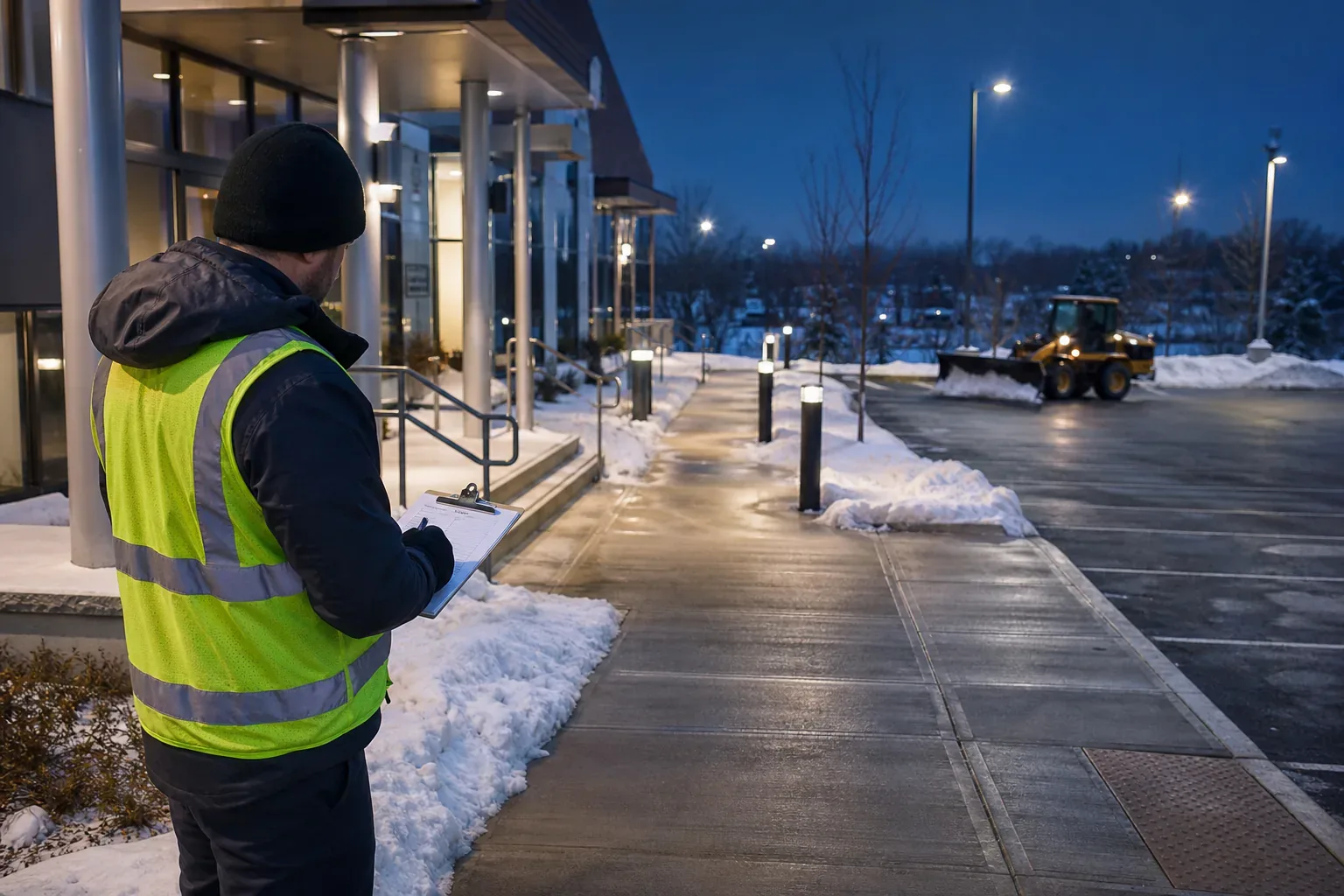
A commercial snow removal contract is the difference between a storm being a logistics event and a liability event. In the DMV, where a two-inch ice storm shuts down more parking lots than a ten-inch snowfall, what matters is not owning plows. It is monitoring, pre-treatment, trigger discipline, and proof of service.
Levaru provides commercial snow removal and ice management across Northern Virginia, Washington DC, and Maryland as part of our facility management service, with every visit logged and photographed on our platform.
How Do Commercial Snow Removal Contracts Work?
Commercial snow contracts come in four basic structures: seasonal fixed price, per-event, per-inch tiers, and time and materials. The right one depends on how much budget certainty you need versus how much weather risk you are willing to carry.
Seasonal fixed price
One flat price for the winter, regardless of how many storms hit. You get a predictable budget line and the contractor carries the weather risk. In a light winter you will pay for service you did not use; in a heavy one, the contractor absorbs the overage. Best for owners who need a fixed number for budgeting or lease pass-throughs.
Per-event
You pay each time crews mobilize, triggered at a contracted depth. Cheap in a mild winter, expensive in a bad one. The fine print matters: a long storm can legitimately count as multiple service events, and the contract should define how.
Per-inch tiers
Each event is billed by accumulation bands: 2 to 4 inches at one rate, 4 to 8 at another, and so on. It tracks actual effort more fairly than flat per-event pricing, but you need an agreed measurement source written into the contract to avoid arguing about totals.
Time and materials
You pay for hours and salt actually used. Fully transparent and fully unpredictable. Reasonable for garages or small sites; risky as the sole structure for a large lot in a heavy winter.
Rule of thumb: seasonal pricing buys budget certainty, per-event and per-inch pricing buys a cheaper mild winter. Pick based on which surprise you can afford, a wasted line item or a blown budget.
Pre-Storm Monitoring and Brine Pre-Treatment
Good snow work starts a day or two before the flakes. We track the forecast, stage equipment and salt, and confirm crew assignments while the storm is still over Ohio.
When pavement temperatures and the forecast call for it, we apply liquid brine to lots and walks before the storm. Anti-icing prevents the bond between ice and pavement, so the first plow pass scrapes clean instead of polishing an ice layer, and it does the job with less total salt than reactive spreading. In this region, where storms routinely start as snow and finish as freezing rain, that pre-treatment pass is frequently the whole ballgame.
Sidewalks, Lots, and Garages Are Three Different Jobs
Parking lots are plow-and-salt work: push to designated stacking areas that do not block sightlines or bury drains and hydrants.
Sidewalks, entrances, steps, and ADA ramps are hand and small-machine work with walkway-appropriate de-icer, and they are where slip-and-fall claims actually happen. DMV jurisdictions also set deadlines for clearing public sidewalks after snowfall ends, and your plan has to meet the local ordinance.
Garages fail at the edges: entrance aprons, exposed top decks, and ramps where meltwater drains and refreezes overnight. Top-deck work also has to respect the structure; a garage deck is not a place to stack ten tons of snow or douse in chlorides without thought.
Slip-and-Fall Liability: Why the Service Log Is the Product
When a slip-and-fall claim lands, the question is always the same: what was done, and when? An invoice that says “plowing, January” defends nothing.
Every Levaru snow visit is logged as a work order on our platform with timestamps, areas serviced, materials applied, and photos of finished surfaces. That record sits in your client portal the same day, ready for your insurer or attorney if a claim ever surfaces. Insurers and defense attorneys ask for exactly this documentation, and properties that have it resolve claims from a very different position than properties that do not.
In snow and ice management, the documentation is not paperwork after the work. It is half the work. Service without a timestamped record is a liability story waiting for its other half.
The Mid-Atlantic Storm Reality
DMV winters are not Buffalo winters, and that is exactly the trap. The dangerous events here are ice storms, wintry mix, and the freeze-thaw cycle: daytime melt draining across a lot, refreezing into black ice by the evening rush. A site that was clear at 3 p.m. can be a skating rink at 7 p.m. with zero new precipitation.
That is why our scope includes post-storm refreeze checks and spot treatment on the days after an event, not just the storm itself. It is also why snow response coordinates with our 24/7 emergency response line for the failures winter causes indoors, like burst pipes and roof leaks under snow load.
We take on snow contracts across our DMV service area, from Alexandria and Fairfax to Bethesda, Rockville, and Baltimore. Routes and salt are committed in the fall, so if you want your property on one, the time to talk is before the first forecast, not during it.
FAQ
Snow & Ice Management — common questions
How do commercial snow removal contracts work?
Most contracts follow one of four structures: a seasonal fixed price covering all events, per-event pricing triggered at an accumulation threshold, per-inch tiers where cost scales with snowfall depth, or time and materials. Seasonal contracts give you a flat budget; per-event and per-inch shift risk toward you in heavy winters and save money in light ones. The contract also defines trigger depths, priority areas, and response times.
When should I sign a snow removal contract for my property?
Before the season, ideally by early fall. Contractors allocate equipment, salt supply, and route capacity in October and November, and properties that call during the first storm get whatever capacity is left, at storm pricing. Signing early also allows a proper site walk to map sidewalks, drains, hydrants, and snow stacking areas before they are buried.
What is a trigger depth in a snow contract?
The accumulation threshold, commonly one or two inches, at which the contractor automatically mobilizes without waiting for your call. Lower triggers cost more per season but keep surfaces continuously passable. The trigger should be written into the contract along with response time and which areas get cleared first, so there is no debate at 4 a.m. about whether crews should have rolled.
Who is liable if someone slips and falls on my commercial property?
Property owners in Virginia, DC, and Maryland generally owe a duty of reasonable care to keep walkways safe, and slip-and-fall claims turn on what was done and when. A contract with defined service levels plus timestamped service records showing when crews plowed, shoveled, and applied de-icer is the core of the defense. This is general information, not legal advice; your attorney and insurer should review your specific situation.
What is brine pre-treatment and is it worth it?
Brine is a salt solution applied to dry pavement before a storm. It prevents the initial bond between ice and pavement, so the first plow pass scrapes closer to black pavement instead of leaving compacted pack. It uses less total salt than chasing ice after the fact and buys time on sidewalks during morning arrivals. For most DMV commercial sites, where ice is a bigger threat than deep snow, it earns its cost.
Do you clear sidewalks and parking garages or just lots?
All three, and they are handled differently. Lots get plows and salt trucks. Sidewalks, entrances, ADA ramps, and steps get crews with shovels, snow blowers, and walkway-rated de-icer. Garage work is mostly at entrances, exposed top decks, and ramps, where meltwater refreezes. Jurisdictions across the DMV also set deadlines for clearing public sidewalks after snowfall ends, and the plan has to meet them.
Next step
Tell us about your building. We'll show you what we'd do with it.
Curious how it works? See how our 3D walkthroughs work →