
Service pillar
Commercial Facility Management in the DMV
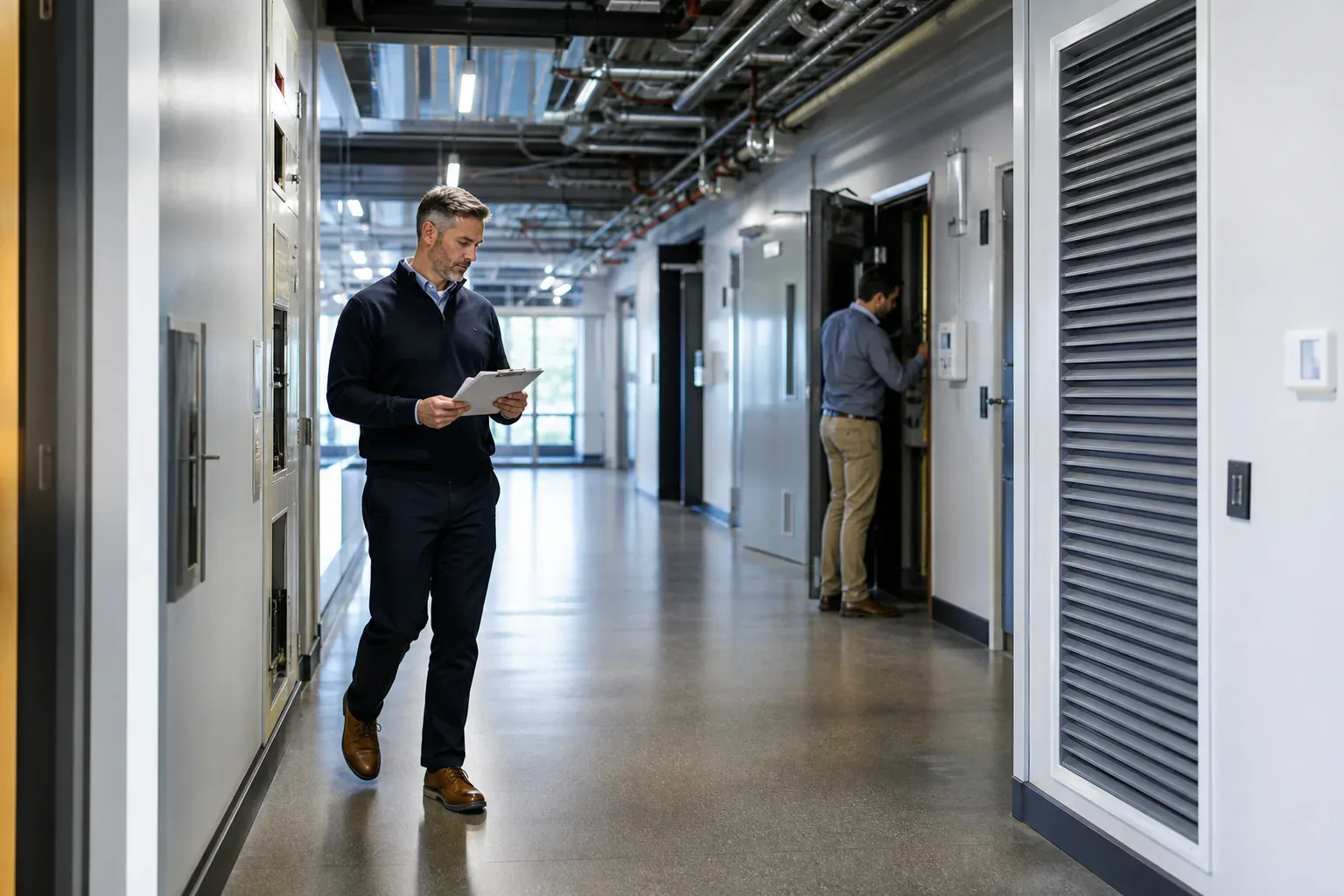
HVAC Maintenance
Commercial HVAC maintenance for DC, Virginia, and Maryland buildings. Quarterly PM for RTUs, chillers, and boilers, photo-documented. Request a proposal.
Janitorial Services
Commercial janitorial services in Northern Virginia and the DMV: day porters, night crews, photo-documented QA inspections. Get a walkthrough and quote.
Preventive Maintenance
Preventive maintenance programs for commercial buildings across the DMV, tracked with QR asset tags and photo-proof work orders. Request a proposal.
24/7 Emergency Response
24/7 emergency building repair across Virginia, DC, and Maryland. One number, fast triage, make-safe dispatch, photo-documented repairs. Call anytime.
Snow & Ice Management
Commercial snow removal for the DMV: seasonal or per-event contracts, brine pre-treatment, and timestamped service logs. Get a snow plan quote.
Electrical Services
Commercial electrical maintenance for DC, Virginia, and Maryland buildings: panels, lighting, emergency power, licensed trade work managed under one program.
Plumbing Services
Commercial plumbing for DC, Virginia, and Maryland buildings: restrooms, drains, water heaters, backflow, freeze protection — one documented program.
Compliance Inspections
Building compliance managed as a calendar: fire alarm, sprinkler, elevator, backflow, generator inspections tracked and documented for DC, VA, and MD.
Security Services
Building security as a managed program: access control, cameras, guard vendor management, and after-hours response for DC, Virginia, and Maryland properties.
Landscaping & Grounds
Commercial landscaping and grounds care for DC, Virginia, and Maryland properties: mowing to stormwater facilities, documented and managed year-round.
Pest Control
Commercial pest control run as integrated pest management: inspection, exclusion, sanitation, and licensed treatment for DC, Virginia, and Maryland buildings.
Hiring a facility management company comes down to one question: who is accountable when something in your building breaks, leaks, trips, or fails an inspection? Levaru provides integrated facility management for commercial buildings across Northern Virginia, Washington DC, and Maryland, from our headquarters in Alexandria. One contract, one point of contact, and a documented record of every piece of equipment in your building.
Most owners come to us after living with the alternative: a rolodex of trade vendors, invoices that don’t match the work, and no real picture of what condition the building is in. Integrated facility management replaces that with a single program that covers the mechanical systems, the cleaning, the grounds, and the compliance calendar, all reported through one platform you can open in a browser.
What Does a Facility Management Company Do?
A facility management company takes responsibility for the physical operation of your building: maintaining the HVAC, electrical, and plumbing systems, managing janitorial and grounds crews, scheduling preventive maintenance, coordinating specialty vendors, handling emergencies, and keeping the property compliant with inspections and codes. In practice, it means you make one call instead of ten, and one company answers for the result.
The day-to-day work is unglamorous and specific. Changing filters on rooftop units before cooling season. Testing backflow preventers because the water authority requires it annually. Getting the fire alarm inspected on the NFPA 72 schedule and keeping the report on file for the fire marshal. Chasing down a slab leak at 2 a.m. Re-lamping a parking garage before someone trips in the dark.
A good facility manager also runs the paperwork side: warranty tracking so you don’t pay for covered repairs, vendor certificates of insurance so an uninsured sub never sets foot on your roof, and a maintenance history you can hand to a buyer, lender, or insurance adjuster when they ask.
Hard Services vs. Soft Services in Facility Management
Hard services are the ones attached to the building: HVAC, electrical, plumbing, roofing, elevators, fire and life safety, and the building envelope. If it fails, something stops working or becomes unsafe. Soft services are the ones that keep the building usable and presentable: janitorial services, grounds and landscaping, snow removal, pest control, security, and waste handling.
The distinction matters because the failure modes are different. Hard-service failures are expensive and sudden: a compressor grounds out, a sewage ejector quits, a transformer fails on the hottest week of July. Soft-service failures are slow and reputational: a lobby that looks tired, restrooms tenants complain about, a sidewalk that stays icy until 10 a.m.
Hard services keep the building running. Soft services keep the tenants. A facility program that funds one and starves the other will eventually pay for both, at emergency rates.
An integrated program manages both under one scope, one budget, and one reporting standard, so nothing falls in the gap between “the HVAC guy” and “the cleaning company.”
Self-Perform Plus Managed Vendors, One Accountable Party
Levaru runs a hybrid model. Our own technicians handle the recurring work where speed and familiarity matter: routine maintenance, commercial HVAC maintenance, general repairs, punch-list items, and first response. For licensed specialty trades like elevators, fire suppression, roofing, and high-voltage electrical, we manage qualified subcontractors under our supervision.
Here is what that means for you in practice. We write the scopes, competitively bid the work, verify licenses and insurance, schedule the vendor, walk the job when it’s done, and photograph the result before the invoice gets approved. If a sub’s work fails, that is our problem to fix, not yours to referee.
You get one contract and one consolidated invoice. When something goes wrong, there is no triangle of finger-pointing between the owner, the vendor, and the manager. The accountability sits with us, in writing.
Preventive First, Break-Fix Last
The cheapest repair is the one that never becomes an emergency. Every Levaru building gets a preventive maintenance calendar built during onboarding: every serviceable asset gets identified, tagged, and put on a schedule based on manufacturer intervals and how the equipment is actually used.
What the Preventive Schedule Covers
That looks like quarterly filter changes and coil inspections on air handlers. Annual boiler combustion checks before heating season. Belt and bearing inspections on exhaust fans. Water heater anode checks. Roof drain clearing before the fall rains. Exercising isolation valves so they turn when you actually need them to.
The Cost of Deferring It
Deferred maintenance doesn’t save money; it moves the cost to the worst possible moment. The rooftop unit that skipped three filter changes fails on a July afternoon with tenants in the building, and now you’re paying overtime rates plus expedited freight on a compressor. Our 24/7 emergency response team exists for the failures nobody can predict. The preventive program exists to keep that phone from ringing.
A useful rule of thumb: if you cannot name the last time a piece of equipment was serviced, you are already paying for deferred maintenance. You just haven’t received the invoice yet.
Your Building, Documented: How the Platform Changes Ownership
The biggest difference between Levaru and a traditional maintenance contractor is what you can see. Every building we manage is documented on our own technology platform, and every client gets access to it.
What the Platform Shows You
Concretely, that means:
- Photo-documented work orders. Every task closes with before-and-after photos. You approve work you can see, not a line item on an invoice.
- QR-coded asset tags. Every serviceable asset in your building carries a tag. A technician scans it and pulls the full service history, model, serial, and open issues on the spot. So does the next technician, three years from now.
- Preventive maintenance scheduling. The PM calendar runs in the system, not in someone’s head. Overdue tasks are visible, not forgotten.
- 360° photo documentation and 3D walkthroughs. Each floor of your building is captured and viewable in a browser, with an interactive floor plan. You can walk your property from your desk, whether that desk is in Bethesda or another time zone.
What This Means for You
For an owner, this is the end of managing by phone call. Open the client portal, see the open work orders, check the photos, walk the floors. When you refinance, sell, or renew insurance, the documented history is already sitting there.
All of it is included with our management services at no extra cost — no software licenses, no per-seat fees, no modules to buy. We built the platform to run our own operations; giving you full visibility into it costs us nothing extra, so it costs you nothing extra.
How an Engagement Works: Assess, Stabilize, Optimize
We onboard buildings in three phases, and we tell you up front what each one involves.
Phase 1: Assess
We walk the entire property with your team. Every serviceable asset gets identified, photographed, condition-rated, and QR-tagged. We capture the floors for the 3D record, pull existing vendor contracts and service history if any exists, and flag life-safety and compliance gaps first. You get a written condition report with a prioritized list: what’s urgent, what’s coming, what can wait.
Phase 2: Stabilize
We fix the urgent items, stand up the preventive maintenance calendar, transition or rebid vendor contracts, and establish emergency response coverage. This is where the deferred-maintenance backlog gets triaged. The goal of this phase is simple: no more surprises.
Phase 3: Optimize
With the building stable and a few months of real data in the system, we work the operating cost. Right-sizing service frequencies, consolidating vendors, planning capital replacements before failures force them, and identifying utility waste. Owners who want to go deeper on energy spend can extend into our energy management program.
How Facility Management Pricing Works
There is no honest one-size number, but the structures are standard across the industry and worth understanding before you take bids.
The Three Pricing Structures
Fixed monthly fee. A defined scope for a flat rate. Predictable for budgeting, best for stabilized buildings where the workload is known. Watch the scope language: a cheap fixed fee with a narrow scope just moves the real cost into change orders.
Per square foot. Common for portfolios and larger properties. Useful for comparing bids, but the rate only means something alongside the scope and service frequencies behind it.
Cost-plus. Actual labor and materials plus a management fee. The most transparent structure, and a good fit when the workload is uncertain, like a building with a deferred-maintenance backlog. The photo documentation in our platform makes cost-plus auditable instead of a leap of faith.
What Moves the Price
What moves the number in any structure: building size and age, equipment count and condition, required hours of coverage, service frequencies, union or prevailing-wage requirements, and how much of the deferred backlog needs to be worked off in year one. Be suspicious of any bid quoted without a site walk.
How Levaru Compares to National Firms
Owners evaluating a facility management provider often put us beside the large national platforms — see our honest, model-vs-model breakdown of Levaru vs. JLL, our JLL, CBRE, and Cushman & Wakefield alternatives guides, and the underlying in-house vs. outsourced math. Each guide names where the enterprise model wins and where a regional, self-perform team like ours is the better fit.
Who This Is For
Levaru manages commercial properties across the DMV: multi-tenant office buildings where presentation and uptime drive renewals, retail and shopping centers where the parking lot and storefronts are the first impression, industrial and flex space, and medical buildings with stricter compliance demands.
If you own or operate commercial property in Alexandria, Arlington, Fairfax, Tysons, Washington DC, Bethesda, Rockville, or Baltimore, we will walk the building, tag the assets, and give you a real assessment before you sign anything. Request a proposal or call +1 (703) 646-8300 to schedule the site walk.
FAQ
Facility Management — common questions
What is included in facility management services?
A full facility management program covers hard services like HVAC, electrical, plumbing, and life-safety systems, plus soft services like janitorial, grounds, snow removal, pest control, and security. It also includes preventive maintenance scheduling, vendor management, compliance inspections, 24/7 emergency response, and reporting. The facility manager becomes the single point of accountability for everything that keeps the building running.
What is the difference between facility management and property management?
Property management handles the business side of a building: leases, rent collection, tenant relations, and budgets. Facility management handles the physical side: maintaining equipment, coordinating trades, running preventive maintenance, and responding to breakdowns. Many owners use both. Levaru offers each as a standalone service or as one combined program under a single contract.
How much does facility management cost for a commercial building?
Most contracts are priced one of three ways: a fixed monthly fee for a defined scope, a per-square-foot rate, or cost-plus with a management fee on top of actual labor and materials. The number moves with building size, equipment age and count, service frequency, hours of coverage, and how much work is self-performed versus subcontracted. A site assessment is the only honest way to quote it.
Does Levaru serve buildings outside of Alexandria?
Yes. Levaru is headquartered in Alexandria, Virginia and serves the full DMV region: Northern Virginia, Washington DC, and Maryland. Primary coverage includes Alexandria, Arlington, Fairfax, Tysons, Washington DC, Bethesda, Rockville, and Baltimore. Emergency response and scheduled maintenance are available across the entire service area.
What is a digital twin in facility management?
It is a documented digital record of your physical building. At Levaru that means QR-coded asset tags on equipment, photo-documented work orders, 360-degree photo documentation, and browser-based 3D walkthroughs of each floor tied to an interactive floor plan. Owners can inspect their buildings remotely at any time instead of relying on phone calls and paper reports.
Can a facility management company take over an existing vendor contract mid-term?
Usually, yes. Most vendor agreements can be assigned or managed by a third party, and month-to-month arrangements can be transitioned quickly. During onboarding we review every existing contract, keep the vendors that perform, rebid the ones that do not, and consolidate billing so you receive one invoice and one accountable point of contact instead of a dozen.
Next step
Tell us about your building. We'll show you what we'd do with it.
Curious how it works? See how our 3D walkthroughs work →