
Facility Management
24/7 Emergency Response for Commercial Buildings
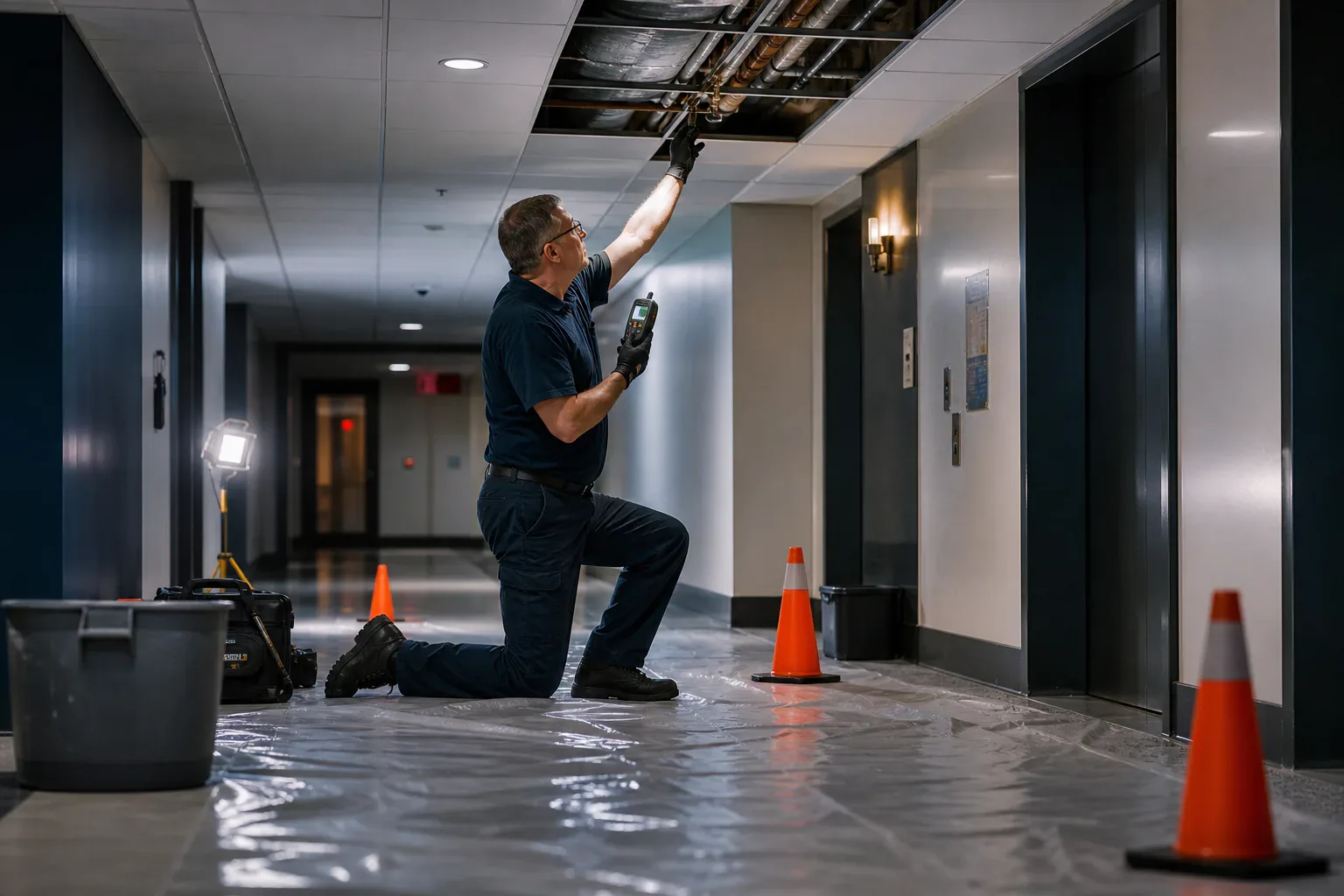
When a pipe bursts above a tenant space at 2 a.m., the only thing that matters is how fast someone competent gets there. Levaru runs 24/7 emergency building repair across the DMV as part of our facility management service: one number, a human answer, and a technician dispatched with a clear make-safe objective.
Emergency building maintenance is not a marketing line for us. It is a defined call flow with triage rules, dispatch priorities, and documentation standards, because at 2 a.m. nobody should be improvising.
What Counts as a 24/7 Emergency Building Repair
Some calls can wait for morning. These cannot:
- Burst pipes and active leaks. Supply lines, heating loops, failed water heaters. Water damage compounds by the minute.
- Flooding and sewer backups. Storm intrusion, failed sump pumps, main line backups into occupied space.
- No heat or no cooling in extreme weather. A dead boiler in January or a failed rooftop unit in a July heat wave is a habitability problem, and in some leases a compliance problem.
- Power loss. Whole-building outages, tripped mains, burning smells at a panel.
- Roof leaks over occupied space. Active dripping onto tenants, inventory, or electrical equipment.
- Storm damage. Wind-thrown debris, broken glazing, compromised roofing after the mid-Atlantic’s summer storms and nor’easters.
- Break-ins and board-ups. A building that cannot be secured is an emergency until it can be.
- Elevator entrapments. The elevator contractor and fire department handle extraction; we manage the escalation, meet responders on site, and handle communication and follow-up.
If damage is spreading or people cannot safely occupy the space, call. Triage is our job, not yours.
The Call Flow: Answer, Triage, Dispatch, Stabilize, Follow Up
Every emergency call runs the same sequence.
Answer. A person picks up, day or night. You describe what is happening; we pull up the building.
Triage. Is anyone in danger? Is damage spreading? Can an on-site person stop it right now? Many water events shrink dramatically because the dispatcher walked someone to an isolation valve while the truck was still moving.
Dispatch. The right trade goes out with the building’s access details, shutoff locations, and equipment history already in hand. For contract clients this information is in our platform before it is ever needed.
Stabilize. The technician’s first job is make-safe: stop the water, kill power to the affected circuit, tarp the roof, board the opening, set drying equipment.
Follow up. Within a business day you get a scope and price for the permanent repair, scheduled as planned work at planned-work rates.
The same sequence covers the vendors we coordinate rather than replace. Restoration and drying companies, glass boards-ups, the elevator contractor, the utility: we know who to call in each jurisdiction and we stay on site until the right one shows up. You make one call; managing the rest of them is our problem, not yours.
Make-safe first: the first visit exists to stop the loss, not to finish the repair. Stabilize the building tonight, then fix it properly in daylight with the right parts and pricing.
Documentation You Can Hand to Your Insurer
Every emergency call becomes a work order on our technology platform with timestamped photos: the damage on arrival, the make-safe work performed, and the state of the site when we left. All of it lands in your client portal, alongside the building’s 360° photo documentation showing pre-loss conditions.
Adjusters want a timeline with evidence. A photo record created the night of the event, with timestamps you did not have to reconstruct from memory, is exactly that. Owners who have been through one contested water claim never want to go without it again.
Why Buildings on a PM Contract Have Fewer Emergencies
Most “sudden” failures are not sudden. The burst pipe was a corroded fitting a plumber would have flagged. The no-heat call was a boiler that skipped its pre-season service. The flooded garage was a sump pump nobody had tested since spring.
That is why our emergency line is quietest for buildings on a preventive maintenance program. Scheduled inspections catch the corroded fitting, the cracked heat exchanger, and the dead sump pump while they are still cheap, boring line items. Emergency response is the backstop. PM is the plan.
Where We Respond
Our emergency coverage matches our service area: Northern Virginia including Alexandria, Arlington, Fairfax, and Tysons; Washington DC; and Maryland including Bethesda, Rockville, and Baltimore. Our HQ is in Alexandria, and we keep the footprint deliberately tight. Emergency response over a two-hour radius is a promise nobody keeps; across the DMV, it is a drive we make every week.
If you manage commercial buildings in that footprint, set up the relationship before you need it. When we already hold your access details, shutoff locations, and equipment history, the response starts the moment you hang up. Call +1 (703) 646-8300 or send us a note; either way, put the number somewhere your night staff can find it.
FAQ
24/7 Emergency Response — common questions
What counts as a building emergency?
Anything that threatens people, property, or the ability to occupy the space: burst pipes or active flooding, total loss of heating or cooling in extreme weather, power loss, roof leaks over occupied areas, storm damage, break-ins that leave the building unsecured, and sewer backups. If damage is spreading or the building cannot be safely occupied, treat it as an emergency and call rather than filing a routine request.
How fast can Levaru respond to a building emergency?
The line is answered around the clock and dispatch begins as soon as triage confirms an emergency. Actual arrival time depends on where the building is and conditions on the ground; our service area is concentrated in the DMV, including Alexandria, Arlington, Fairfax, Tysons, Washington DC, Bethesda, Rockville, and Baltimore, which keeps travel distances short. While a technician travels, we walk your on-site contact through immediate steps like shutting an isolation valve.
What should I do while waiting for emergency repair to arrive?
Keep people away from the hazard first. For water events, close the nearest shutoff valve if you can find it safely. For electrical issues, do not touch wet panels or equipment. Take photos if it is safe to do so, and note when the problem started. Our dispatcher will stay on the line and walk your on-site contact through the specific steps for your situation.
Does emergency repair include the permanent fix?
The first visit is about stabilizing: stopping water, restoring heat or power where possible, boarding openings, and preventing further damage. Some problems are fully resolved on the spot. When they are not, we scope the permanent repair, provide pricing, and schedule it as regular work at regular rates. You are never left with a temporary patch and no plan.
Will I get documentation for my insurance claim?
Yes. Every emergency call becomes a work order in our platform with timestamped photos of the damage on arrival, the make-safe work performed, and the condition we left the site in. That record lives in your client portal and can be shared with your adjuster directly. Photo documentation captured on the day of the event is consistently what makes insurance claims move.
Do I need a service contract to call for emergency repair?
Contract clients get priority dispatch and their building information, access details, and shutoff locations are already in our system, which saves real time at two in the morning. We take non-contract emergency calls in our service area when capacity allows. If you own or manage buildings in the DMV, the better answer is to have the relationship in place before the pipe bursts.
Next step
Tell us about your building. We'll show you what we'd do with it.
Curious how it works? See how our 3D walkthroughs work →