
Industry
Facility & Property Management for Industrial & Warehouse Facilities
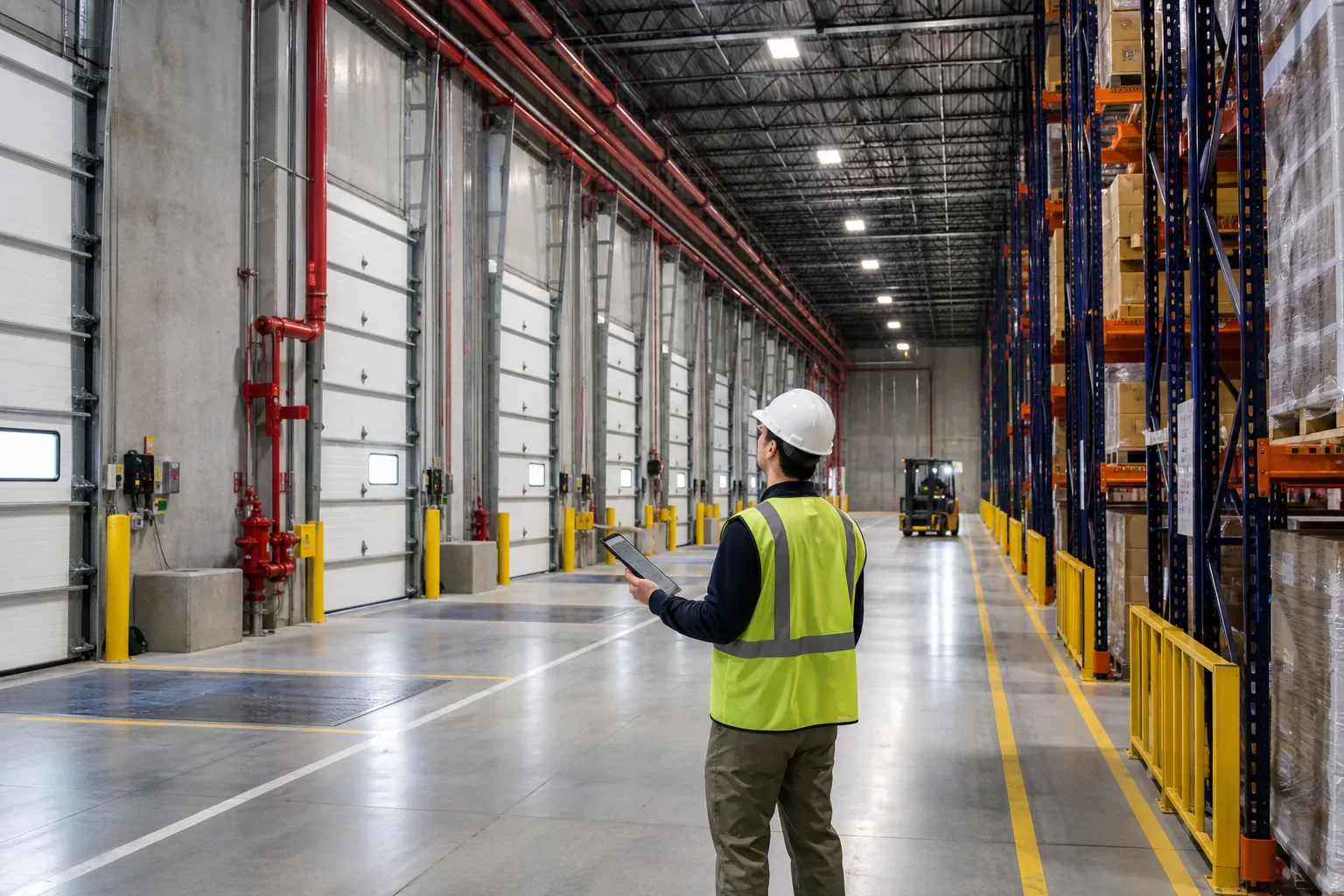
Industrial buildings look simple from the street: four walls, a flat roof, dock doors. The owners who lose money on them learn otherwise, usually through a roof that failed over a tenant’s inventory or a truck court that quietly turned to gravel. Levaru provides industrial property management and warehouse facility maintenance across the DMV for warehouse, flex, and light-industrial buildings in Virginia, Washington DC, and Maryland.
We are a facility management and commercial real estate firm headquartered in Alexandria, VA. On industrial product the scope is narrower than office but the stakes per item are higher, so the program is built around the handful of systems that actually carry the risk.
Warehouse facility maintenance, from the roof down
On a warehouse, the roof is most of the job. It is the largest single component, the most expensive to replace, and the one whose failure lands on someone else’s property: the tenant’s racking, product, and equipment sitting underneath it.
On an industrial building, manage the roof and the paving and you have managed most of the risk. Nearly everything else is a repair; those two are capital events.
Our roof program is preventive maintenance in its purest form: scheduled inspections, drains and scuppers cleared, seams and penetrations checked, every rooftop trade visit logged because HVAC techs and telecom installers cause a large share of membrane damage. Each roof section is documented with photos on our platform, so you have a condition history to plan capital against and a record that keeps the manufacturer’s warranty intact.
How often should a warehouse roof be inspected?
Twice a year at minimum, spring and fall, plus after major storms and after any contractor has been up there. Small punctures and clogged drains are cheap findings on a scheduled walk and expensive surprises once water finds the insulation.
The fall inspection matters most in the DMV: it is your last look before freeze-thaw cycles start working every seam and ponding area on the roof. The written record matters as much as the fix. A documented inspection history supports warranty claims, insurance conversations, and the eventual sale, where a buyer’s engineer will price uncertainty against you.
Dock doors, levelers, and the cost of a dead position
A dock position that is down is a piece of the tenant’s operation that is down, and they will tell you about it immediately. Doors, levelers, seals, shelters, and bumpers take a beating from daily trailer traffic and forklift contact.
We put dock equipment on a service schedule: springs, cables, tracks, and operators inspected and adjusted, levelers cycled and lubricated, damaged panels and photo eyes fixed before a door fails in the open position in January. Every dock position is QR-tagged, so a tenant reporting “door 14” creates a work order against the exact asset with its full history attached.
Fire suppression and life safety, on the calendar
Sprinkler systems in warehouses are not optional infrastructure, and neither are their inspections. Annual and periodic testing of sprinkler systems, fire pumps, alarms, extinguishers, and exit lighting has to happen on schedule, with the paperwork to prove it to the fire marshal, the insurance carrier, and any tenant whose own compliance depends on the base building.
We contract and calendar the inspections, walk the deficiencies to closure, and file the reports where the owner can retrieve them in minutes. A missed inspection is the kind of finding that surfaces at the worst time: after an incident, or in a buyer’s due diligence.
Paving, lighting, and the exterior
Truck courts fail faster than car lots; a loaded trailer does the pavement damage of a great many sedans. We manage asphalt and concrete on a cycle of crack sealing, patching, and planned overlays so you choose the timing of the spend instead of the pavement choosing it for you.
Exterior and warehouse lighting is the other quiet win. LED retrofits on high-bay fixtures and pole lights cut energy and maintenance costs, and better light levels improve site security and tenant safety scores. We scope and run these through our energy management practice, sized against the actual utility spend rather than a vendor’s brochure math.
NNN tenants expect lean OpEx, and they audit it
Industrial tenants sign NNN leases with sharp expectations: low, predictable pass-throughs and no padding. The way to meet that is not to skip maintenance, it is to do maintenance on purpose. Planned work at bid prices is consistently cheaper than emergency work at whatever-it-costs prices, and it keeps the reconciliation defensible line by line.
Many of these tenants also run second and third shifts, so building failures do not wait for business hours. Our 24/7 emergency response covers the calls that cannot sit until morning: power loss, sprinkler trips, doors stuck open in freezing weather, and active roof leaks over product.
Where we work: Baltimore, I-270, and Northern Virginia
The DMV’s industrial demand runs along its freight corridors: the Baltimore market with its port-driven warehouse base, the I-270 corridor through Rockville and up-county Maryland where flex and light-industrial serve the region’s lab and contractor economy, and the Northern Virginia infill markets where older industrial buildings sit on land everyone wants. Different submarkets, same fundamentals: keep the roof tight, the docks running, and the OpEx honest.
If you own warehouse or flex space in the region, request a proposal. We start on your roof, literally, and hand you a documented condition baseline whether or not you hire us for the rest.
FAQ
Industrial & Warehouse — common questions
What does warehouse facility maintenance typically cover?
The building envelope and the systems the lease leaves with the landlord: roof inspections and repairs, dock doors and levelers, fire suppression and life-safety inspections, exterior lighting, paving and truck courts, landscaping, snow, and structural items. Levaru documents each asset with QR tags and photo-verified work orders so owners of NNN buildings can prove exactly what was spent and why.
How often should a warehouse roof be inspected?
Twice a year at minimum, spring and fall, plus after any major storm or any rooftop trade work. Most industrial roof failures start as small punctures, clogged drains, or failed seams that cost little to fix when caught early and a great deal once water reaches insulation, racking, or tenant inventory. A documented inspection history also protects warranty coverage.
Do you support tenants that run around the clock?
Yes. Distribution and light-industrial tenants often run second and third shifts, so we schedule preventive maintenance around their operations and staff a 24/7 emergency line for the failures that cannot wait: dock doors stuck open in winter, power loss, sprinkler trips, and roof leaks over stored product. Response is dispatched and photo-documented regardless of the hour.
Can you keep operating expenses low on a NNN industrial building?
That is the core of the job. Industrial tenants sign NNN leases expecting lean, predictable pass-throughs, and they audit them. We keep OpEx defensible through preventive maintenance that avoids premium-priced emergency work, competitively bid vendor contracts, lighting retrofits that cut common utility costs, and documentation that makes every reconciliation line traceable to real work.
Where do you manage industrial property?
Across Virginia, Washington DC, and Maryland, including the Baltimore industrial market and the I-270 corridor through Rockville, plus Northern Virginia flex space around Alexandria, Fairfax, and beyond. Levaru is headquartered in Alexandria, VA. Call +1 (703) 646-8300 or email info@levaru.co about a specific building or portfolio.
Next step
Tell us about your building. We'll show you what we'd do with it.
Curious how it works? See how our 3D walkthroughs work →