
Facility Management
Commercial HVAC Maintenance in the DMV
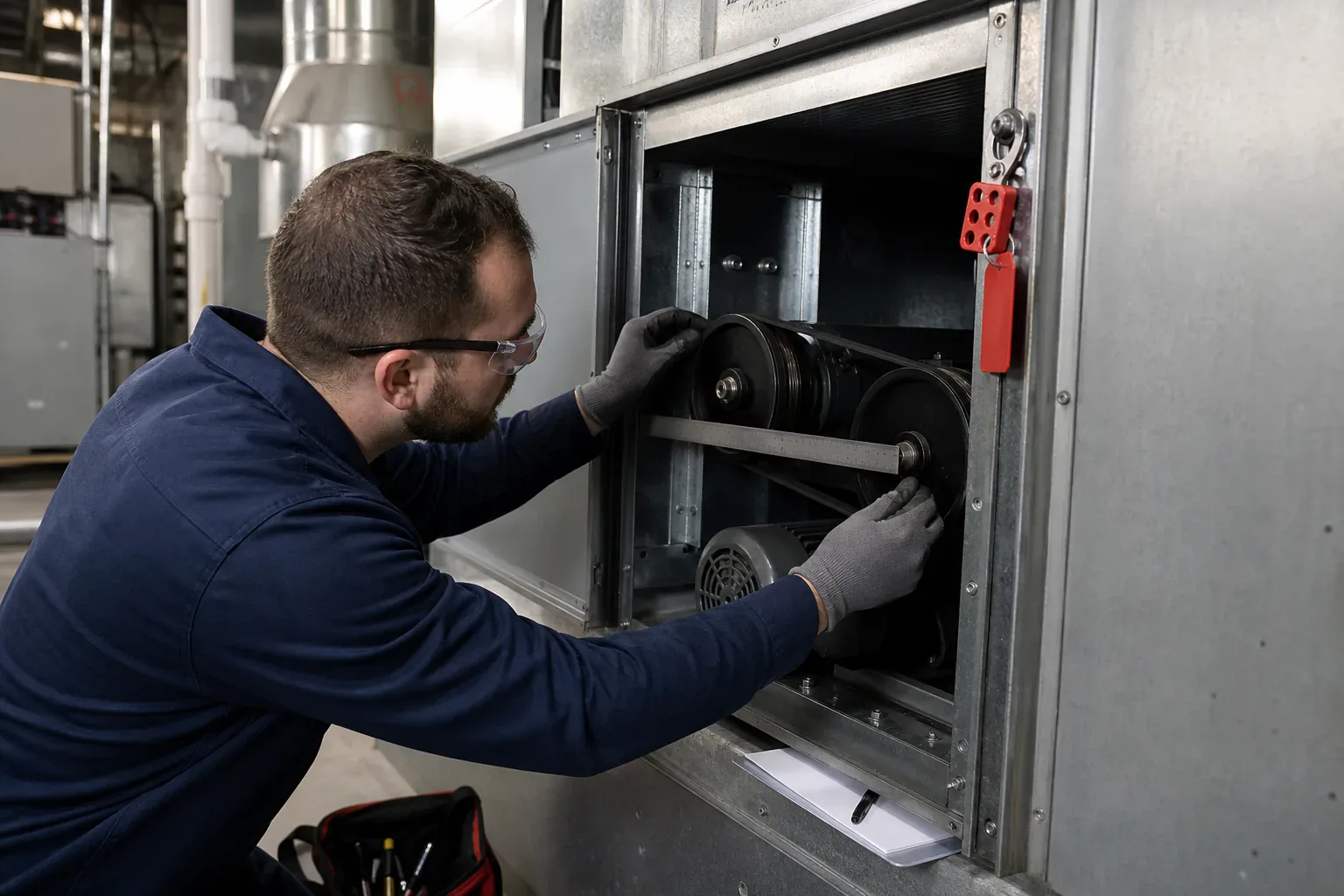
Commercial HVAC maintenance is the least optional line in your building’s operating budget, because HVAC is where deferred maintenance converts directly into emergency invoices and tenant complaints. Levaru maintains commercial HVAC systems across Washington DC, Northern Virginia, and Maryland: rooftop units, split systems, chillers, boilers, cooling towers, VAV boxes, and the building automation systems that tie them together. Every visit is photo-documented in your client portal, tied to a QR tag on the unit itself.
If your current arrangement is “call somebody when it stops cooling,” you don’t have a maintenance program. You have a repair account with extra steps.
What a Real Commercial HVAC PM Program Covers
The equipment list in a typical DMV commercial building runs from packaged rooftop units on retail and flex space, to splits and heat pumps in smaller offices, up to chiller plants, boilers, and cooling towers in larger buildings. Each has its own failure habits, so each gets its own task list.
A quarterly visit on a rooftop unit, done properly, looks like this:
- Replace filters, and record the size and count so nobody guesses next quarter
- Inspect and clean evaporator and condenser coils; a matted condenser coil makes the compressor work harder and die younger
- Check belt condition, tension, and alignment; inspect bearings and lubricate where specified
- Clear and treat the condensate drain and pan, the number one source of “water coming through the ceiling” calls
- Inspect electrical connections, contactors, and capacitors; loose lugs and pitted contactors kill compressors
- Verify refrigerant charge and inspect for leaks, performed by EPA Section 608 certified technicians with the work logged per unit
- Test thermostat or BAS control response, economizer operation, and safety cutouts
Seasonal work sits on top of that cycle. Spring means cooling startup: condenser cleaning, charge verification, cooling tower cleaning and water treatment checks. Fall means heating: burner inspection, combustion testing on boilers and gas furnaces, heat exchanger inspection for cracks, and verifying freeze protection before the first hard night.
On buildings with VAV systems and building automation, we verify that boxes actually respond to their zones and that the BAS schedule matches how the building is really occupied. A BAS that is quietly running the building nights and weekends is one of the most common energy leaks we find during onboarding.
How Often Should Commercial HVAC Be Serviced?
Quarterly, for most commercial equipment, with the spring and fall visits carrying the heaviest task lists. That baseline covers the filter, coil, belt, drain, and electrical items that cause the majority of breakdowns. High-runtime equipment, dusty environments, and critical spaces like server rooms or medical suites justify monthly filter service between full visits.
Chillers, boilers, and cooling towers need more than the quarterly cycle: annual teardown-level inspections, combustion analysis on boilers, and ongoing water treatment on towers and closed loops. Skipping tower water treatment isn’t just an efficiency problem; fouled and stagnant towers are a legionella risk, and scale buildup quietly ruins heat transfer long before anything visibly fails.
If a unit’s filters have not been changed in six months, the money you saved is already gone. It left through the utility meter and it is coming back as a compressor invoice.
The DMV Climate Is Hard on Equipment
This region punishes HVAC systems from both ends. Summers are long, humid, and increasingly hot: cooling equipment runs at sustained high load from June into September, and humidity means condensate systems work constantly. A marginal drain that would be fine in Denver floods a ceiling tile in Arlington.
The shoulder seasons are the other trap. Spring and fall in Virginia, DC, and Maryland swing between heating and cooling in the same week, which means economizers, changeover controls, and heat pumps cycle constantly, and control faults show up as comfort complaints nobody can reproduce. Winter adds freeze-thaw: coil freeze protection, hydronic lines in exterior walls, and condensate traps on rooftops all become failure points during the first real cold snap. We build the fall PM visit around exactly those items.
Deferred PM Doesn’t Disappear. It Reschedules Itself as an Emergency
Here is the pattern we see in buildings we take over. A filter change gets skipped, airflow drops, the coil ices, the compressor runs hot and overdrafts its windings. Nothing dramatic happens for months. Then the first 95-degree week arrives, the unit fails with the building full, and the repair happens at overtime rates with parts on expedited freight, followed by a tenant relations problem that outlasts the repair.
Our emergency response team handles genuine surprises around the clock. But most “emergencies” we respond to in newly acquired buildings were visible on an inspection sheet months earlier. The whole point of a preventive maintenance program is to find the pitted contactor in April instead of meeting it in July.
Rule of thumb: an HVAC failure almost never happens on a mild day. Load exposes weakness, so the breakdown arrives at peak demand, peak rates, and peak tenant attention.
Every Unit Tagged, Every Visit Photographed
Every unit we maintain carries a QR-coded asset tag. A technician scans it and sees the unit’s full history: model and serial, filter sizes, refrigerant type and logged charge activity, past repairs, and open issues. No tribal knowledge, no starting from zero when a different tech shows up.
Every PM visit closes with photos in the client portal: the dirty coil before, the clean coil after, the belt that’s cracking and will need replacement next quarter. You can audit the work from your desk without climbing a roof ladder, and when a unit finally reaches end of life, the documented history makes the replace-versus-repair decision an actual analysis instead of a guess. This is a piece of the broader documentation platform behind our facility management program.
How Commercial HVAC Maintenance Contracts Are Priced
Three structures cover most of the market:
Per unit, per visit. Priced off the equipment list. Straightforward and easy to compare across bidders, as long as every bidder saw the same equipment list and roof.
Flat annual PM contract. A fixed fee covering the scheduled visits across all equipment, usually billed monthly. Repairs found during PM are quoted separately. This is the most common structure for office and retail buildings.
Full coverage. PM plus repairs, sometimes including parts, for a higher fixed fee. It caps your exposure and makes budgeting simple, priced according to the age and condition of the fleet. Nobody should sell you full coverage on 18-year-old rooftop units without a frank conversation first.
What moves the price: unit count and tonnage, equipment age, filter quantities, roof and mechanical room access, controls complexity, and whether the building needs after-hours service windows.
If your equipment list is out of date or doesn’t exist, that’s a normal starting point; building it is the first thing we do. Request a proposal and we’ll walk the roof, tag the units, and quote from what’s actually up there.
FAQ
HVAC Maintenance — common questions
How often should commercial HVAC systems be serviced?
Quarterly is the working standard for most commercial equipment, with heavier visits in spring before cooling season and fall before heating season. Filters may need changing monthly in dusty or high-traffic buildings. Chillers, boilers, and cooling towers carry their own annual requirements on top of the quarterly cycle. The right interval depends on runtime hours, equipment age, and how critical the space is.
What is included in a commercial HVAC preventive maintenance contract?
A typical scope covers filter changes, coil cleaning, belt and bearing inspection, condensate drain treatment, electrical connection checks, refrigerant circuit inspection by EPA 608 certified technicians, thermostat and control verification, and seasonal startup and shutdown of heating and cooling equipment. Each visit should end with a written and photographed report of what was done and what was found.
How much does commercial HVAC maintenance cost?
Most contracts are priced per unit per visit or as a flat annual fee across the equipment list. The cost drivers are unit count, tonnage, equipment age, roof access difficulty, filter quantity and size, and whether the scope is inspection-only, labor-inclusive, or full-coverage with parts. A full-coverage contract costs more per month but caps your repair exposure.
Why is my rooftop unit freezing up or leaking water into the ceiling?
The two most common causes are airflow starvation and a blocked condensate drain. A clogged filter or iced coil reduces airflow until the coil freezes, then floods the drain pan when it thaws. A condensate line clogged with algae overflows the pan directly into the ceiling below. Both are preventable with routine filter changes and drain treatment, which is exactly what a quarterly PM visit covers.
Do you handle refrigerant work and EPA compliance?
Yes. Refrigerant recovery, charging, and leak repair are performed by EPA Section 608 certified technicians, and refrigerant activity is logged per unit. That record matters: EPA rules require leak tracking on larger systems, and a documented refrigerant history also tells you when a unit is becoming a candidate for replacement rather than another recharge.
Next step
Tell us about your building. We'll show you what we'd do with it.
Curious how it works? See how our 3D walkthroughs work →