
Industry
Facility & Property Management for Retail & Shopping Centers
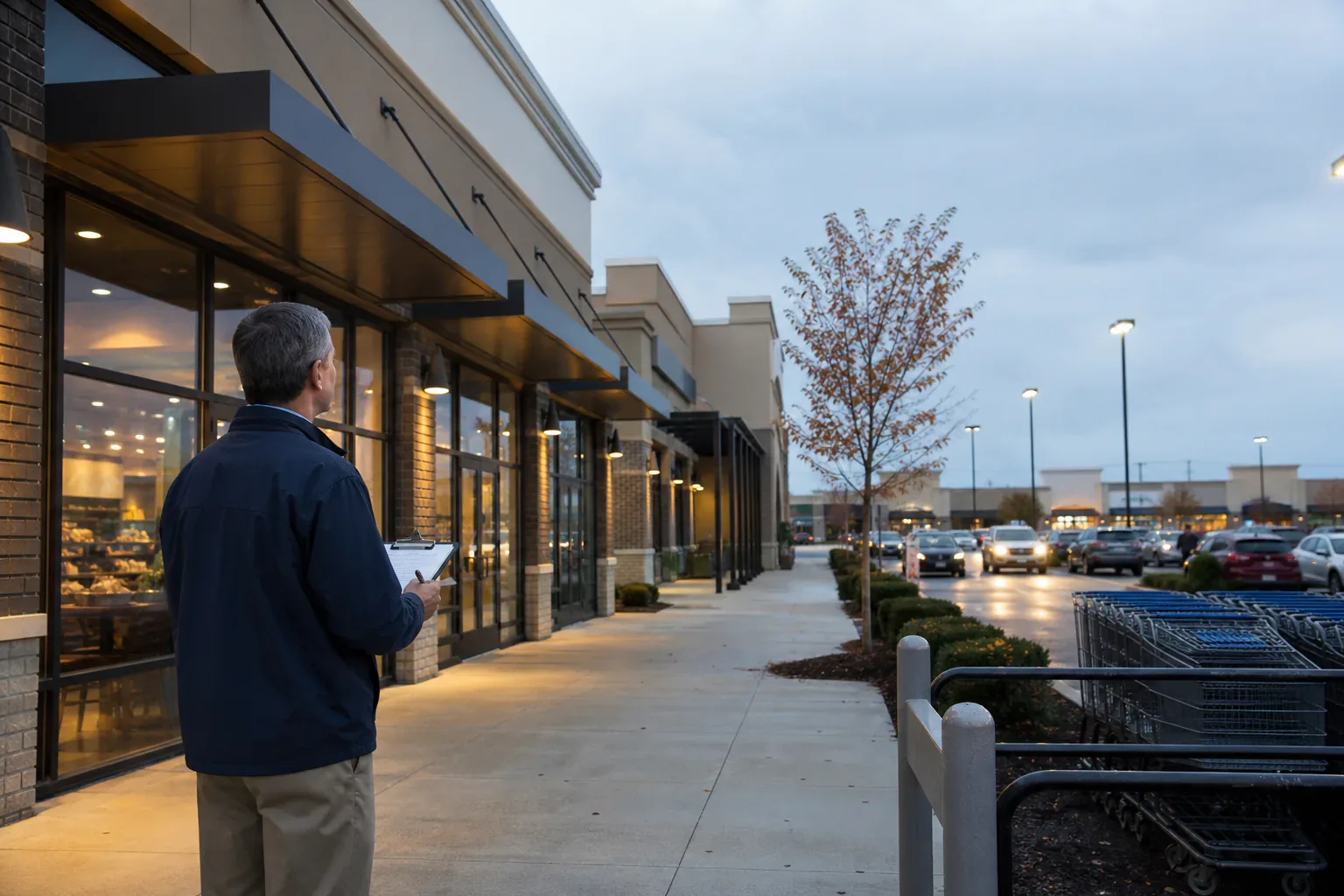
A strip center earns its rent in the first fifty feet: the pothole at the entrance, the burned-out pole light, the snow berm blocking three parking spaces. Customers judge your tenants by your site, and your tenants judge their renewal by their sales. Levaru provides retail property management and shopping center maintenance across the DMV for strip centers, neighborhood centers, and standalone retail in Virginia, Washington DC, and Maryland.
We are a facility management and commercial real estate firm based in Alexandria. For retail owners we combine site-level maintenance with the ownership-side work, budgeting, CAM, lease files, and vendor contracts, under one property management relationship.
Retail property management starts in the parking lot
The parking lot is the biggest asset most retail owners neglect. Faded striping, alligatored asphalt, and dark corners tell customers the center is declining before they ever reach a storefront.
We manage pavement like the capital asset it is: crack sealing and sealcoating on a cycle, striping refreshed so the lot reads clean at night, potholes patched before they eat a customer’s rim and become a claim. Site lighting gets walked after dark, because a photocell failure you only check at noon stays dark for months. Cart corrals, bollards, curb stops, and signage get the same treatment: small items, but they are the center’s handshake.
Lighting is also a safety issue. A well-lit lot at 9 p.m. keeps evening traffic coming and keeps your insurance carrier calm. Dark spots show up in incident reports and premises-liability claims before they show up in tenant complaints. We track pole and canopy fixtures as tagged assets, so an outage becomes a work order with a photo of the repair, and repeat failures on the same circuit get diagnosed instead of endlessly re-lamped.
What should CAM reconciliation look like?
It should be a statement tenants can verify, not a number they have to take on faith. A clean reconciliation shows budgeted versus actual by category, ties the big line items to real invoices and real work, and arrives on the schedule the lease promises.
The way you get there is boring and yearly: log common-area work orders with photos as they happen, code vendor invoices to the right pools, track actuals against budget monthly instead of discovering the overage in February. Our lease administration work keeps the abstracts, caps, exclusions, and pro-rata shares straight so the reconciliation matches what each lease actually says. Tenants fight CAM when it is a black box. Ours is a folder of documented work they can open in the portal.
CAM is the most audited number in retail real estate. If you cannot show a tenant the work behind their share, expect to write a credit. If you can, reconciliation is a mailing, not a negotiation.
Turnover, vanilla shell, and getting the space trading again
Retail vacancy is more visible than office vacancy. A papered storefront drags on every neighbor’s sales, and on co-tenancy math too: in centers with co-tenancy clauses, one anchor going dark can give inline tenants rent relief or exit rights. Leasing speed is an operations problem as much as a brokerage problem.
We run the turnover cycle tight: secure and de-identify the space at move-out, document its condition, then deliver the vanilla shell or full buildout the new lease requires through our tenant improvement team. Because the same firm maintains the center, the buildout ties into roof, HVAC, and electrical systems we already know, which is how you avoid the classic handoff failures at delivery.
Snow response for open-air centers
An enclosed mall clears sidewalks. An open-air center clears everything, and it has to be done before stores open or every tenant loses the day. In the DMV, one badly handled storm can cost a center more goodwill than a year of good maintenance earns back.
Our snow removal program is contracted before the season: trigger depths defined, priority zones mapped, entrances, fire lanes, walks, and ADA routes first, salt and ice-melt staged on site, completion documented with time-stamped photos. Slip-and-fall defense starts with that documentation, not after the claim letter arrives.
Weekend and holiday coverage, because that is when retail trades
Retail breaks on Saturday afternoon. A tripped panel, a backed-up sewer line, or a door that will not lock is not a Monday problem when the center does its best volume on the weekend.
Levaru runs 24/7 emergency response with escalation paths your tenants actually have: a number that answers, a tech dispatched, and a photo-documented resolution in the client portal so the owner sees what happened without chasing anyone. Store managers remember who showed up on Sunday. So do their corporate real estate teams when renewal comes around.
If you own retail in Virginia, DC, or Maryland, request a proposal. We will walk the site, lot, roofs, lighting, and vacant suites included, and give you a scope built on what the center actually needs.
FAQ
Retail & Shopping Centers — common questions
What does retail property management include for a strip center?
Everything the center needs to trade well: parking lot maintenance and striping, site lighting, landscaping, trash and common-area cleaning, roof and storefront repairs, snow and ice response, vendor management, CAM budgeting and reconciliation, lease administration, and tenant coordination. Levaru documents the work with photo-verified work orders so owners and tenants can see what their CAM dollars actually bought.
How do you keep CAM charges defensible at reconciliation?
By building the record all year instead of at year end. Every common-area work order is logged with photos, vendor invoices tie to specific tasks, and budgets are tracked against actuals monthly. When reconciliation letters go out, the backup already exists. Tenants dispute CAM when it looks like a black box; they pay it when they can see the parking lot repairs and snow invoices behind the number.
Do you handle snow removal for open-air shopping centers?
Yes. Retail snow response is pre-contracted before the season with defined trigger depths, priority zones for entrances, walks, and fire lanes, and documented completion times. An open-air center that is not cleared by store opening loses that day''s sales for every tenant, so we plan it as a revenue-protection service, not just plowing.
Can you get a vacant retail space ready for a new tenant?
Yes. We handle vanilla-shell and full buildout work through our projects team: demising walls, storefront and door work, HVAC, electrical panels and distribution, restrooms, and code items, delivered to the condition the lease promises. Because we already maintain the center, the buildout crew knows the building systems it is tying into.
Which retail properties and areas do you serve?
Strip centers, neighborhood centers, and standalone retail across Virginia, Washington DC, and Maryland, including Alexandria, Arlington, Fairfax, Tysons, Bethesda, Rockville, and Baltimore. We are headquartered at 5510 Cherokee Ave Ste 300 in Alexandria, VA. Call +1 (703) 646-8300 or email info@levaru.co to talk through a specific center, its tenant mix, and what the site needs first.
Next step
Tell us about your building. We'll show you what we'd do with it.
Curious how it works? See how our 3D walkthroughs work →