
Projects & Construction
Commercial Project Management & Owner's Representation
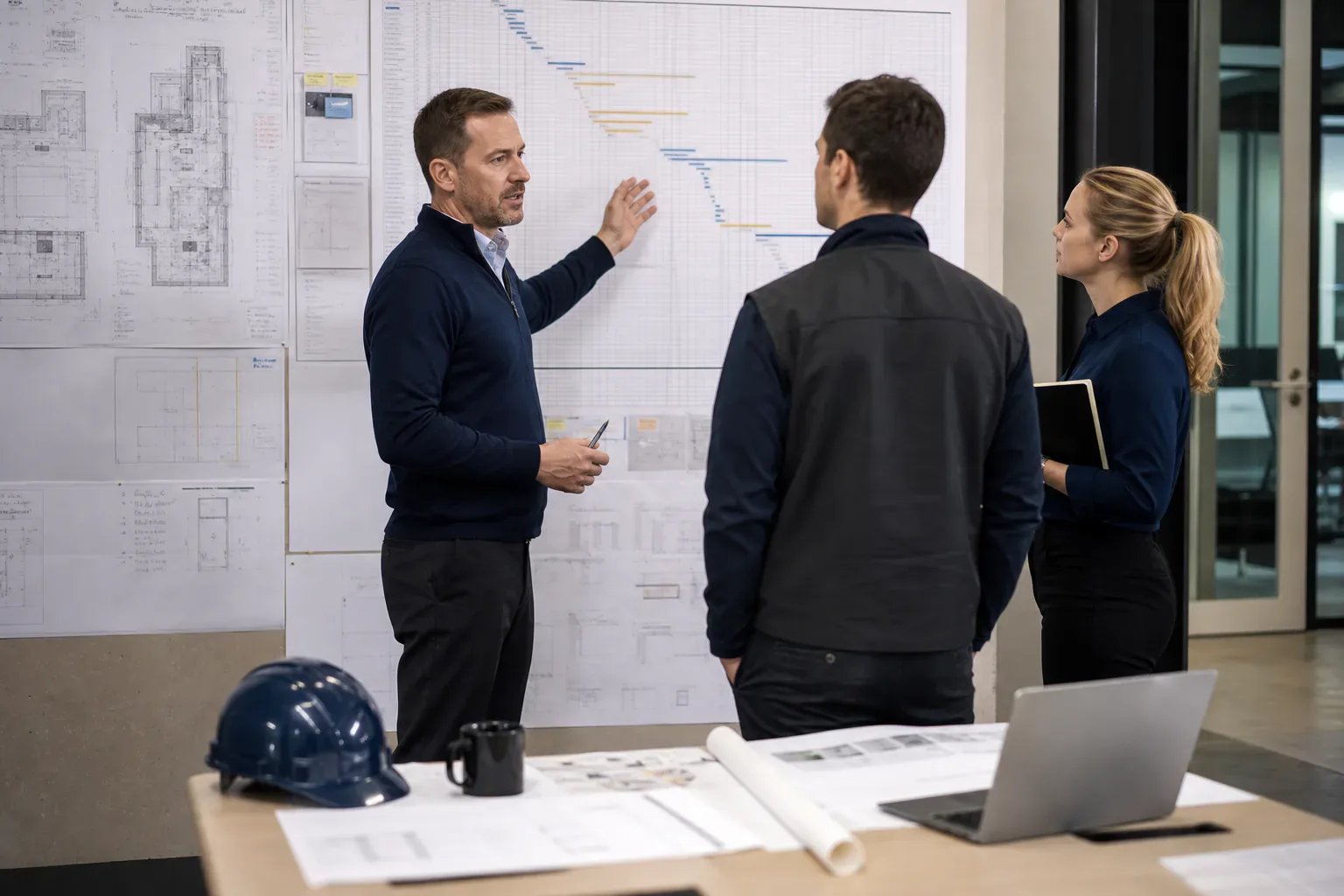
Commercial project management is owner-side leadership of a construction project from first idea to final closeout: writing the program, controlling the budget, coordinating designers, running the bid, supervising the contractor, and defending the schedule. Levaru provides project management and owner’s representative services for commercial buildings across the DMV, from our headquarters in Alexandria, Virginia, as the lead discipline in our projects and construction practice.
The role exists for one reason: on a construction project, no one else is paid to protect the owner. The architect answers to the design. The contractor answers to the construction contract. Someone has to answer to the person funding the work, full time and in writing. That is the job we do.
What Owner-Side Project Management Covers
An owner’s representative manages the project on the owner’s behalf across its whole life, not just during construction. That means the decisions made long before a permit is filed, the ones that quietly set the final cost, get made deliberately instead of by default.
The work is a long sequence of unglamorous choices made early enough to still be cheap. Writing a program tight enough that three contractors price the same building. Building a budget that carries every cost, not just construction. Choosing a delivery method that fits the project instead of the one the last firm happened to use. Structuring the bid so exclusions surface before award, not as change orders in month two.
An owner’s representative is the only party on a project whose sole financial interest is the owner’s outcome. Everyone else at the table is paid by the project.
Project Management or Construction Management?
The two roles overlap enough that the terms get used interchangeably, but they are not the same thing. Project management is the broader, earlier discipline: it owns the budget, the design coordination, and the procurement strategy from day one. Construction management is the field-level work that runs once the project is under way, focused on quality, submittals, schedule, and paying only for work actually in place.
On most of our engagements we provide both, which is the point. The person who wrote your budget is the same one reading a pay application against the wall six months later. Nothing falls into the seam between two firms, because there is no seam.
One Accountable Manager, One Weekly Report
The core deliverable of project management is not a document; it is accountability. You get a single named manager who owns the outcome and a weekly written report that answers three questions plainly: what happened this week, what it cost against budget, and what needs a decision from you.
That report is the antidote to the way projects actually fail, which is quietly, one unremarkable week at a time. A schedule slips one trade. A change order appears without backup. An allowance gets spent without anyone deciding to spend it. Owners rarely get one big bad surprise; they get a dozen small ones nobody flagged. A disciplined weekly cadence turns those into decisions you make on purpose.
When to Engage a Project Manager
Owners hire us in two situations. The first is a project large enough that a full-time internal manager would make sense but does not exist, a renovation, a floor consolidation, a building repositioning. The second is a portfolio where projects arrive irregularly, so building an internal team leaves it idle between jobs.
Either way the earlier the better. The largest cost decisions on any project are made during scoping and design, when a change costs a redline instead of a change order. A manager brought in before design pays for the fee several times over in avoided rework. One brought in after bids open is doing damage control, which is worth doing but is not where the leverage lives.
Permitting Across DMV Jurisdictions
Every project in this region answers to a different rulebook depending on where the building sits. Alexandria, Arlington, Fairfax County, the District, Montgomery County, and Baltimore each run their own plan-review queues, inspection practices, and trade-permit requirements. The submittal that cleared one county draws comments in the next.
We plan permitting jurisdiction by jurisdiction, track review comments, and never let a contractor start work ahead of the permit, because unpermitted work discovered at inspection stops the entire job. In an occupied building, the building’s own rules, certificate-of-insurance requirements, freight windows, after-hours work limits, are just as binding and belong in the bid documents so contractors price them.
From Project to Operations, Under One Roof
Most project managers hand you the keys and disappear. Because Levaru also operates buildings, our projects close out into an operating plan: assets tagged, preventive maintenance schedules loaded, and the whole job documented in 360° photo records tied to the floor plan. If we manage the building afterward, the transition is a handoff to ourselves. If we do not, you still receive a documented building instead of a box of binders and a warranty period nobody tracked.
Have a project on the horizon in Alexandria, Arlington, Washington DC, Bethesda, or Baltimore? Request a proposal and we will scope it with you before anyone draws a line.
FAQ
Project Management — common questions
What does a commercial project manager actually do for the owner?
An owner-side project manager runs the project on your behalf from first idea to final closeout: writing the program, building and defending the budget, coordinating the design team, running the bid, supervising the contractor, controlling changes, and closing the project out. The manager has no financial stake in the construction itself, so every decision is measured against your outcome rather than the contractor's margin. You get one accountable point of contact and a written record of every decision.
What is the difference between project management and construction management?
Project management is the broader, earlier role: it covers the whole lifecycle, including programming, budgeting, design, and procurement decisions made long before anyone breaks ground. Construction management is the field-level discipline that runs during the build itself, focused on quality, submittals, schedule, and pay applications. On many projects one team provides both. Levaru does, so the person who wrote your budget is the same one verifying work in place against it.
When should an owner bring in a project manager?
Before design starts, not after bids come in. The decisions that set a project's cost, budget, program, scope, and delivery method, are all made during planning, when changes are still cheap. A project manager engaged early pressure-tests the budget and structures the bid so contractors price identical scope. Hiring one mid-crisis still helps, but most of the leverage is already spent by then.
Does Levaru self-perform the construction?
No. As your project manager we sit only on your side of the table and hold no trade contracts, so we have no markup on the work and no conflict when we review a contractor's pricing. We run the bid, hold the general contractor and subcontractors accountable, and verify their work, but the construction contract is between you and the builder. Our fee is for protecting your interests, never a percentage of the changes we approve.
What areas does Levaru manage projects in?
Levaru manages commercial projects across the DMV from its Alexandria, Virginia headquarters, with primary coverage in Alexandria, Arlington, Fairfax, Tysons, Washington DC, Bethesda, Rockville, and Baltimore, and service throughout Northern Virginia, the District, and Maryland. Local presence matters because permitting queues, inspection practices, and building rules differ by jurisdiction, and someone has to be on site when a decision cannot wait.
Next step
Tell us about your building. We'll show you what we'd do with it.
Curious how it works? See how our 3D walkthroughs work →