
Industry
Facility Management for Government & Municipal Buildings
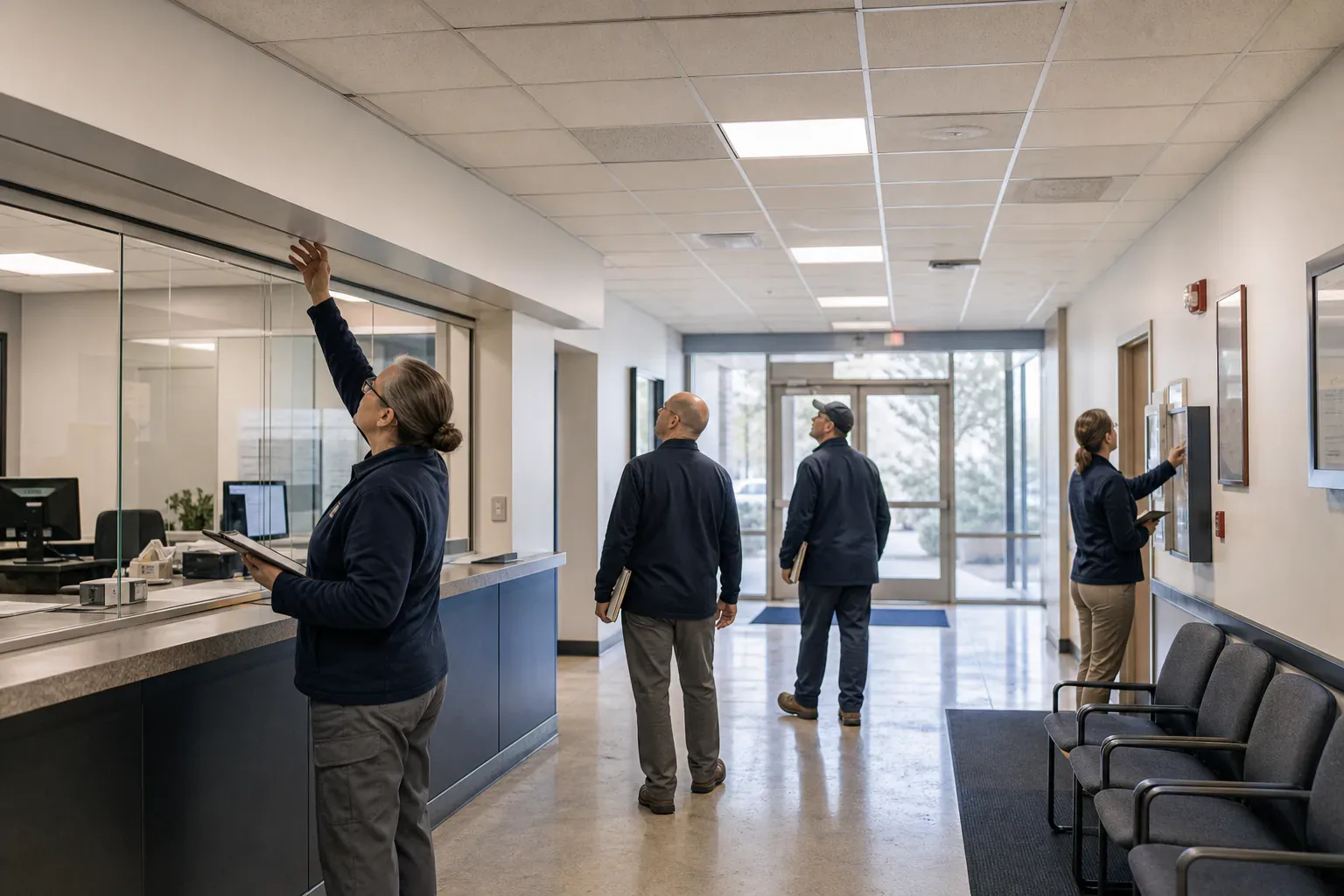
Public buildings are held to a standard private ones are not. They are open to everyone, funded by taxpayers, and audited by people whose job is to ask where the money went. A town hall, a county office building, a public works facility, or a community center is judged in public and defended in budget hearings. Levaru provides facility management for municipal and government buildings across the DMV — Virginia, Washington DC, and Maryland — with the documentation and accountability that public ownership demands.
We are a facility management and commercial real estate firm headquartered in Alexandria, Virginia. We manage the daily operation of public and government-occupied buildings the same way we run private portfolios — preventive maintenance, photo-verified work orders, 24/7 emergency response — but with records built to survive an audit rather than a conversation.
Public buildings run on documentation
In a private building, “we fixed it” is usually enough. In a public one, someone will eventually ask when, by whom, at what cost, and against which line item. That question can come from a council member, an inspector, a records request, or a resident at a meeting, and the answer has to exist.
Every Levaru building runs on our CMMS platform, where each work order is time-stamped, photo-verified, and tied to a QR-tagged asset. When a facilities director needs to show a board that the HVAC serving the council chamber was maintained on schedule, or account for a repair line in next year’s budget, it is an export, not an archaeology project. Transparent records are not a feature we upsell to public clients; they are the baseline the work is built on.
In government work, the record is part of the deliverable. A repair nobody can document, at a cost nobody can trace, is a finding waiting to happen — no matter how well the actual work was done.
Procurement, prevailing wage, and honest scoping
Public work is bought differently. It goes out to bid, it is scored against a written scope, and it often carries wage and reporting requirements private work does not. We scope proposals to the specification as written, price them line by line, and keep the documentation a procurement office needs to defend the award.
Where a project falls under prevailing-wage rules — Davis-Bacon on covered construction, the Service Contract Act on covered services, or a state or local equivalent — we plan and record the work to meet those requirements rather than discovering them mid-contract. We will tell an agency plainly when a scope needs a specialty licensed trade, a bonded subcontractor, or a certification we bring a partner in for. Overpromising to win a public bid is how a young firm ends up in a default no auditor forgets.
Regulated trades, self-performed and supervised
Government buildings carry the same trade-licensing reality as the rest of our portfolio, and we frame it the same honest way. The routine layer — filter changes, lamp and ballast work, minor repairs, grounds, janitorial, preventive maintenance — is self-performed by our crews. Licensed and specialized work — electrical, plumbing, fire and life-safety systems, elevators, and backflow — is performed by licensed subcontractors we manage under supervision, with their credentials and insurance tracked in the same system as the work.
That distinction matters more in public buildings, where a missing permit or an unlicensed repair is not just a liability but a public one.
Compliance calendars that do not slip
Public buildings sit under overlapping inspection regimes — fire and life safety, elevators, backflow prevention, accessibility, and the DC, Maryland, and Virginia authorities that each run their own certification schedules. A missed elevator certification in a private office is a scramble; in a public building it can close a service residents depend on.
Our compliance inspection program tracks every recurring certification against its authority and due date, warns before deadlines instead of after, and keeps the permit numbers and certificates where an inspector or an auditor can find them. Preventive maintenance is scheduled off the actual equipment on site, so the systems the public relies on are worked before they fail, not after.
Access, security, and the public’s expectations
Buildings open to the public carry obligations private ones do not. Accessible routes have to actually function — door operators, ramps, railings, accessible parking, compliant restrooms — because a public building that fails an accessible path fails the people it exists to serve. High-traffic public lobbies, restrooms, and common areas need janitorial work run on inspection scoring, not assumption, and security coordination that respects the tension every public building lives with: open enough to serve residents, controlled enough to protect staff and records.
One accountable partner, one record
Agencies and public-building owners are usually juggling a stack of single-trade vendors and a facilities staff stretched thin. Levaru consolidates the daily operation under one accountable manager and one system of record, so the people answerable to the public can account for the building without chasing six contractors for paperwork.
If you manage a municipal, county, or government-occupied building in Virginia, DC, or Maryland, request a proposal. We will walk the facility, review the compliance calendar you are carrying, and scope a program your next audit will thank you for.
FAQ
Government & Municipal — common questions
Does Levaru hold government contracting certifications or a GSA Schedule?
Levaru is a facility management and commercial real estate firm headquartered in Alexandria, Virginia. We scope every public proposal to the procurement's stated requirements — bonding, insurance, prevailing-wage reporting, and any registrations the solicitation names — and we tell you plainly which we hold directly and which we meet through a bonded, licensed subcontractor or partner. Send us the specifics in your solicitation and we will answer them line by line rather than in generalities.
How do you handle prevailing-wage requirements like Davis-Bacon or the Service Contract Act?
Where a scope is covered by Davis-Bacon on construction, the Service Contract Act on services, or a state or local equivalent, we plan and document the work to meet those requirements from the start instead of discovering them mid-contract. Certified payroll, classifications, and the supporting records are kept where a contracting officer or auditor can pull them without a scramble.
Can you take over a public building from an existing contractor?
Yes. Transitions begin with a full walkthrough where we tag assets with QR codes, inventory the equipment actually on site, and rebuild the preventive maintenance and compliance calendar from that inventory rather than an inherited spreadsheet. Open work orders, vendors, and certification deadlines carry over so the public sees no gap in service and the facilities office keeps a continuous record.
What kinds of government buildings do you manage?
Municipal and county office buildings, town and city halls, public works and fleet facilities, community and recreation centers, libraries, and other government-occupied commercial space across the DMV. We do not take on correctional facilities or secure federal sites that require personnel clearances we do not hold — we will say so plainly rather than bid work we cannot properly staff.
Which areas do you serve?
Virginia, Washington DC, and Maryland, from our headquarters in Alexandria. Primary coverage includes Alexandria, Arlington, Fairfax, Tysons, Washington DC, Bethesda, Rockville, and Baltimore, with service across the broader DMV. Call +1 (703) 646-8300 or email info@levaru.co to confirm coverage for a specific facility.
Next step
Tell us about your building. We'll show you what we'd do with it.
Curious how it works? See how our 3D walkthroughs work →