
Insights
Commercial HVAC Preventive Maintenance Checklist
Levaru Operations Team
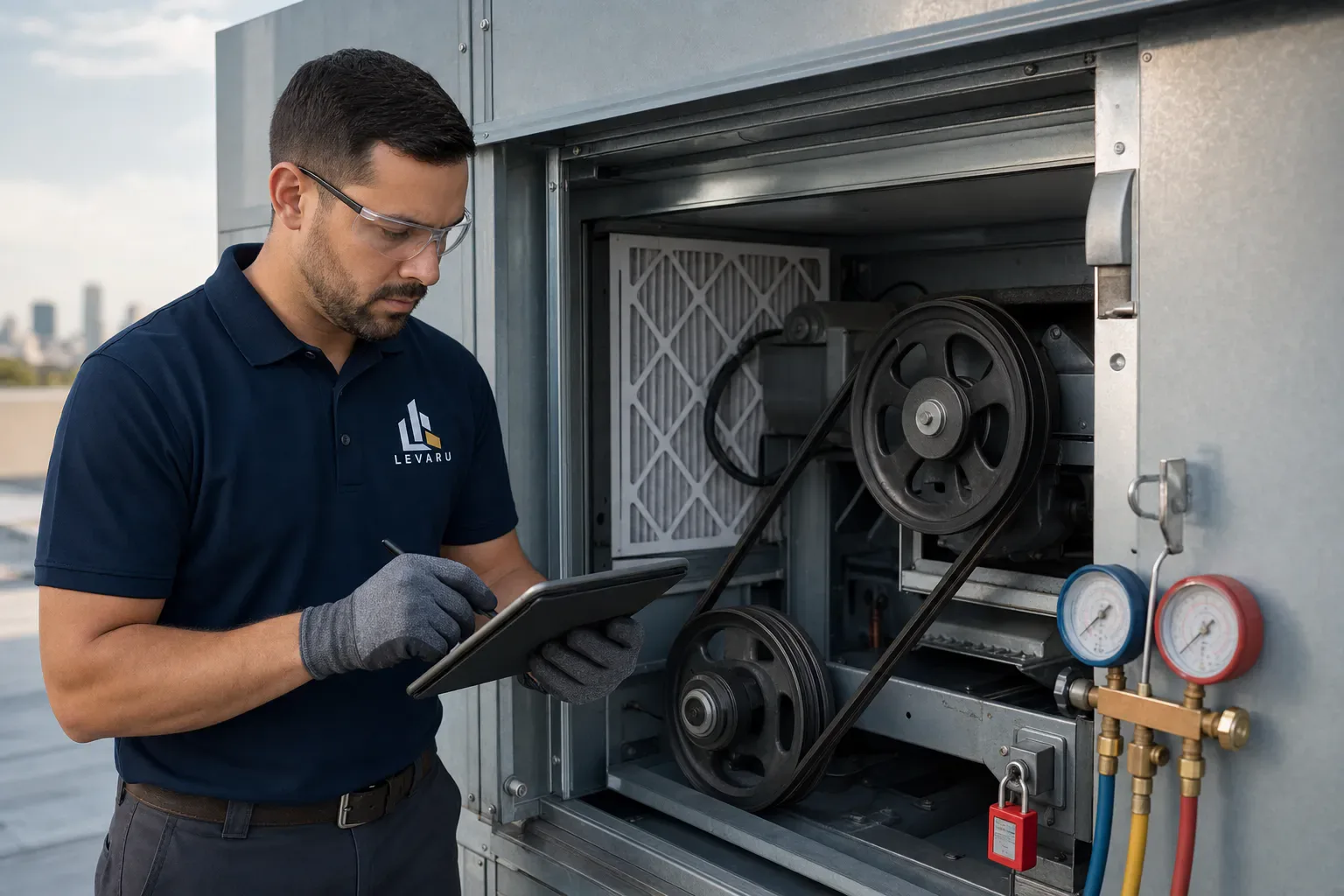
An HVAC preventive maintenance checklist is only useful if it is specific enough to hand to a technician and audit afterward. “Inspect unit” is not a task. “Record filter size and count, verify condensate drain flows, megohm-test the compressor if it tripped last quarter” — those are tasks, and they either got done or they didn’t. This article is the hand-to-a-vendor version: the quarterly and seasonal task lists we expect to see completed, by equipment type, in a commercial building.
Use it three ways. If you already have a PM contract, compare these lists against the scope you’re actually paying for — the gap is usually informative. If you’re bidding out a contract, attach the relevant sections to your RFP so every bidder prices the same work. And if you self-perform with in-house engineers, this is a reasonable baseline task library to load into your maintenance software.
One framing note before the lists: the point of preventive maintenance is not tidiness, it’s failure interception. Almost every summer compressor failure and every winter freeze-up announces itself months earlier as a dirty coil, a slipping belt, a pitted contactor, or a drifting control point. The checklist exists to force someone to look at those things on a schedule, not when the tenant calls.
How often should commercial HVAC equipment be serviced?
Quarterly is the working baseline for most commercial HVAC equipment, with heavier task lists in spring (before cooling season) and fall (before heating season). Filters in dusty or high-traffic buildings may need monthly changes between full visits, and central plant equipment — chillers, boilers, cooling towers — carries annual teardown-level work on top of the quarterly cycle.
In the DMV specifically, the spring and fall visits do the most work. Washington-area summers hold cooling equipment at sustained high load from June through September, and the humidity keeps condensate systems running constantly, so a marginal drain pan found in April is a ceiling stain avoided in July. Fall matters for the opposite reason: the first hard freeze finds every unprotected coil and untraced hydronic line at once.
ENERGY STAR’s Building Upgrade Manual estimates that sound operations and maintenance practices alone can save 5% to 20% on a commercial building’s energy bills, without significant capital investment. — U.S. EPA, ENERGY STAR
What should a quarterly PM visit include for each equipment type?
Every quarterly visit, regardless of equipment, should produce three things: completed task confirmations, readings recorded against the previous visit’s readings, and photos of anything abnormal. The equipment-specific lists below are the minimum scope, not the ceiling.
Packaged rooftop units (RTUs)
- Replace filters; record size, quantity, and condition of the ones removed
- Inspect evaporator and condenser coils; clean when fouling is visible, not on a fixed rotation
- Check belt condition, tension, and alignment; replace cracked or glazed belts; lubricate bearings where specified
- Clear and treat the condensate drain, pan, and trap; confirm positive drainage
- Inspect electrical connections, contactors, capacitors, and relays; torque suspect lugs; record voltage and amp draws per phase
- Verify refrigerant charge via superheat/subcooling and inspect for oil traces at joints (EPA 608 certified tech; log any refrigerant activity per unit)
- Cycle the economizer; verify damper travel, linkage, and changeover setpoint
- Test safety controls: high/low pressure cutouts, freeze stats, condensate overflow switch
- Confirm thermostat or BAS command response and occupied/unoccupied schedule accuracy
Split systems and heat pumps
- Replace filters at the air handler or return grille; record sizes
- Inspect and clean indoor coil and blower wheel; a caked blower wheel silently cuts airflow 20–30%
- Clear condensate drain and pan; verify float switch operation
- Inspect outdoor condenser coil; clear vegetation and debris to maintain clearance
- Check refrigerant line insulation for UV damage and gaps
- Record amp draws; inspect contactor and capacitor
- On heat pumps: verify defrost cycle initiation and termination, and reversing valve operation ahead of heating season
Chillers
- Record full operating log: entering/leaving water temps, refrigerant pressures and approach temperatures, oil pressure and level, amp draw versus rated load amps
- Trend approach temperatures against baseline — rising approach is fouling or charge loss announcing itself
- Inspect purge unit operation (low-pressure machines); log purge run time
- Check oil analysis schedule (annual sample minimum); verify oil heater operation
- Inspect starter/VFD cabinets; scan for hot spots; confirm cooling of drive electronics
- Verify chilled water and condenser water flow switches and safeties
- Annual: eddy current tube testing per manufacturer interval, condenser tube brushing, refrigerant analysis, vibration analysis on open-drive machines
Boilers
- Inspect burner flame pattern; record stack temperature and compare to baseline
- Test low-water cutoff (slow-drain test where applicable) and manual reset controls
- Verify operating, limit, and modulating controls at setpoints
- Inspect for flue gas leaks, casing corrosion, and refractory condition
- Check water treatment: sample boiler water and condensate; log chemical residuals; verify feedwater/makeup meter readings for hidden system leaks
- Blow down per water treatment program; inspect blowdown valves for seat leakage
- Annual (fall): combustion analysis with analyzer printout retained, heat exchanger inspection for cracks or fouling, relief valve inspection, and jurisdiction certificate inspection where required
Cooling towers
- Inspect basin for sediment, scale, and biological growth; clean as needed
- Verify water treatment system operation: chemical feed pumps, conductivity controller, biocide dosing records
- Check fan, gearbox or belt drive, and motor; lubricate per schedule; listen for bearing noise
- Inspect fill, drift eliminators, and spray nozzles for scale and blockage
- Confirm makeup valve and overflow operate correctly; record blowdown/bleed rate
- Verify basin heater and freeze protection ahead of winter
- Maintain the legionella water management program log (ASHRAE 188) — treatment alone is not a program; the documentation is the program
What changes in spring and fall?
Spring and fall visits carry the seasonal changeover work, and they should be scheduled as the heavy visits of the year. Spring is cooling startup; fall is heating startup and freeze protection. A vendor who performs identical scope all four quarters is either overworking the mild visits or, more likely, underworking the critical ones.
Spring (cooling startup — target completion before Memorial Day):
- Condenser coil deep clean on all cooling equipment
- Refrigerant charge verification and leak inspection across the fleet
- Cooling tower cleaning, disinfection, and water treatment startup
- Chiller seasonal startup per manufacturer procedure; confirm safeties before loading
- Verify condensate systems end-to-end — pans, traps, pumps, float switches — before humidity season
- Confirm economizer high-limit changeover so free cooling actually ends when outdoor air gets humid
Fall (heating startup and freeze protection — target completion by late October):
- Burner inspection and combustion analysis on boilers and gas-fired units
- Heat exchanger inspection for cracks (carbon monoxide risk, not just efficiency)
- Verify freeze stats, coil pump interlocks, and glycol concentration where hydronic coils see outdoor air
- Trace and confirm heat tape on exposed condensate lines and rooftop piping
- Heat pump defrost verification; auxiliary/emergency heat staging test
- Cooling tower winterization or winter operation setup, including basin heaters
What documentation should you require from your vendor?
Require a per-unit record, not a per-visit invoice. Each piece of equipment should have its own history: tasks completed, readings logged against prior readings, photos of deficiencies, refrigerant activity, and open recommendations with quotes. When a unit fails, that file is what turns the repair-versus-replace conversation from a guess into an analysis — and when a technician who has never seen your roof shows up, it is the difference between a productive visit and a discovery mission. This is exactly the problem a maintenance platform solves; if you’re not sure what that looks like in practice, see our explainer on what a CMMS is and why paper checklists stop scaling around the third building.
Insist on readings, not checkmarks. A checkbox that says “inspected coil” tells you nothing next year. An amp draw, a superheat figure, and an approach temperature build a trend line, and trend lines are how PM actually predicts failures. If your current contractor resists documenting to this level, that tells you something about what the visits contain. This checklist is the same task library our own technicians work from under Levaru’s commercial HVAC maintenance program, where every visit closes with photos and per-unit records in the client portal.
Finally, connect the HVAC calendar to the rest of your obligations. Boiler certificates, backflow tests, and cooling tower documentation all have jurisdictional deadlines in DC, Maryland, and Virginia that ride alongside the PM cycle — we’ve mapped those out in our building compliance calendar.
Frequently asked questions
Can I use this checklist for an in-house maintenance team?
Yes — it works as a baseline task library for in-house engineers, loaded into whatever work order system you use. The main adjustment is frequency: in-house teams can economically do monthly filter and drain checks that would be expensive as contractor truck rolls, and push the deeper quarterly scope to spring and fall.
What’s the difference between preventive maintenance and an inspection?
An inspection observes and reports; preventive maintenance performs work — filters changed, coils cleaned, belts replaced, drains treated. Inspection-only contracts are cheaper because the labor happens later as billable repairs. Know which one you’re buying before you compare prices.
How do I know if my current vendor is actually completing these tasks?
Ask for the last four visit reports on your two largest units and look for recorded readings, filter sizes, and photos. If the reports are checkmarks with no data, spot-audit: a filter with a six-month dust load, a matted condenser coil, or a slimy condensate pan in week two of a “completed” quarter is your answer.
Do small buildings with a few splits really need quarterly PM?
The equipment still benefits, but the economics can support a semiannual cycle — a spring cooling visit and a fall heating visit — with monthly filter changes handled in-house. What doesn’t work is skipping the condensate scope: in the DMV’s humid summers, drain failures flood ceilings in small buildings just as effectively as in large ones.
What should I do about equipment that’s already past its expected life?
Keep it on the PM cycle — old equipment benefits most from clean coils and tight connections — but stop putting major repair money into it. Ask your vendor for a per-unit condition ranking and use the documented history to schedule replacement on your terms, in shoulder season, instead of the unit’s terms in July.