
White paper
The Handover File: A Facility Manager's Framework for Specifying, Verifying and Taking Delivery of the Operational Record Before the Project Team Leaves
Nikolai Hanov
Published by Levaru
Full paper
The summary below covers the paper's key findings; the full text, methodology and figures are in the PDF.
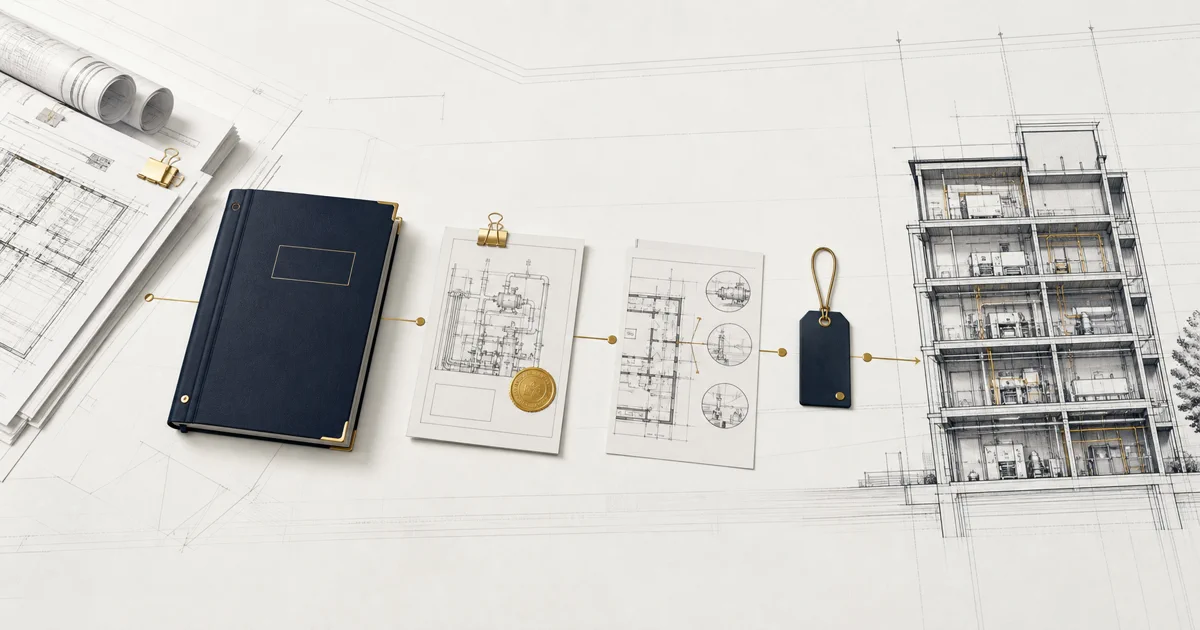
Download the full white paper (PDF)Every completed project, the paper begins, ends in two deliveries. The first is physical and celebrated: the new building, the renovated floor, the replaced central plant — walked, photographed, ribbon-cut and occupied, governed by inspection regimes, punch lists, retainage and certificates of completion. The second is informational and almost invisible: the O&M manuals, record drawings, warranties, commissioning reports and asset data that are supposed to tell the operations team what was just delivered and how to keep it alive — and it is governed, in most organizations, “by a cardboard box.” The pattern is familiar enough to be a genre: binders assembled by submittal number rather than by asset, a drive of scanned files whose names are dates, record drawings that stopped being true somewhere during the punch list, and a warranty package opened for the first time on the day something fails. The project team — the only people who know where anything is inside that delivery — disperses within weeks, and the operations team spends the building’s first years buying back its own facts: climbing ladders to read nameplates that were typed into an equipment schedule two years earlier, and discovering the roof warranty’s penetration clause in the same month a satellite installer unknowingly voids it.
Nothing in that pattern involves anyone failing at their job, Hanov argues — the failure is structural: information is produced in one phase of a building’s life, by organizations who leave, in formats chosen for their convenience, and consumed for decades in another phase by organizations who were rarely asked what they would need. And the loss is measured, not anecdotal: the National Institute of Standards and Technology priced inadequate interoperability in the United States capital facilities industry at US$15.8 billion per year — a figure its authors described as conservative — with two-thirds of it, US$10.6 billion, borne not by the designers or builders who create the information but by the owners and operators who inherit its absence, predominantly during the years the project team is gone. The Handover File proposes that the second delivery be treated with exactly the discipline the first has always received: specified in the contract, delivered against a schedule, verified before acceptance, and owned by a named person on each side of the construction-to-operations boundary. “A building is handed over twice — once as an asset and once as a record — and the second handover sets the operating cost of every year that follows.”
What a Handover File is — and is not
The definition is exact: a specified, verified and operations-ready information deliverable — the subset of project information that operations will actually use — demanded in the contract at project outset, delivered progressively at defined milestones rather than assembled at the end, structured to load into the owner’s systems of record, and acceptance-tested against those systems before the project team is released. Every clause is load-bearing. Specified means the file lives in the procurement documents, because information that was not demanded at kickoff cannot be reconstructed at closeout — “it can only be re-surveyed, at the owner’s expense, by people meeting the building for the first time.” Operations-ready means three layers arrive in three states: asset data as data, in a schema that loads the CMMS; documents indexed to the assets and spaces they describe; and drawings as the maintained record set with a named custodial home. Subset means the file is scoped by operational demand, not project completeness — the remainder of the record is archived, findable, and deliberately left unstructured. The file sits between two established responses: the boxes-and-binders tradition (closeout as a documents-received event, acceptance by weight — cheap, familiar, and useless at the moment of need) and full-model maximalism (the demand for a complete, information-rich building model that routinely produces shelfware, delivered late because the demand was unbounded). The exclusions complete the definition: the file is not a building information model, though it happily takes one; not the commissioning process, though commissioning is its richest single source; not a software purchase; not a punitive instrument for the closeout negotiation; and not a promise the building arrives fully known — judgment does not transfer by deliverable, and the file’s defensible claim is the recordable layer.
Why now
Three published pressures frame the moment, each cited rather than generated. The first: the cost has been priced, and it lands on the owner — the NIST study’s structure being as instructive as its total, because the parties who choose the formats of project information bear about a third of the cost of its failures while the party who inherits the building bears the rest, which explains why the problem persists: the second delivery fails because the people it fails are not at the table where its terms are set. The second: the supply side is ready, and has been for years — NBS’s long-running survey has recorded BIM adoption holding at roughly 70 percent of built-environment respondents since 2018, COBie has offered a standardized handover schema since 2007, and the ISO 19650 series has given the demand side an international vocabulary; yet only 16 percent of the same survey’s respondents had worked on a project involving a digital twin in the preceding year, and the equipment schedule that lived as data in the design model still routinely reaches the owner as a scanned image of itself. “The gap is no longer technological. It is contractual, and it is the owner’s to close.” The third: the operating side can no longer absorb the gap by memory — a study cited in IFMA’s Facility Management Journal found 31 percent of facility management employees eligible to retire between 2022 and 2037, while Gordian puts deferred capital renewal on North American campuses at US$156 per gross square foot: a standing pipeline of renewal projects, each one a handover event, arriving at teams with fewer veterans to catch what the documents drop.
Five properties and four instruments
What separates a Handover File from a document dump is five properties: demand-scoped contents, with a single test applied to every demanded item — name the task, the person and the month in which operations will use it, or the item goes to the archive; specified upstream, in every instrument that produces building information — the general contract, the professional appointments, the commissioning scope, the tenant-improvement rules — because the record is only as complete as the least-obligated party who touched the building; structured for the systems of record, which exposes the difference between delivered and findable — a sequence of operations trapped in an unindexed commissioning report is, operationally, undelivered; acceptance-tested, against a written protocol published at kickoff so verification is predictable rather than punitive; and owned across the boundary by a named operational-readiness owner who joins at design development and holds the file through the warranty year.
Four instruments turn the definition into practice. The Day-One Test is the headline measure: if the project team dissolved at substantial completion — no calls, no texts — what percentage of the questions the building’s first year will ask could operations answer from the delivered information alone? The method is a standing question bank of twenty to thirty questions written from the portfolio’s own operating history — isolation points, filter sizes, TAB setpoints, warranty terms and claim contacts, the roof penetration protocol — scored per project, optionally weighted by criticality. Run empirically at least once per project: give a technician real first-month work orders on the new systems, forbid any call to the project team, and watch where the delivered information fails — “thirty minutes of observed struggle settles arguments that no document review can,” and it settles them while the project team is still under contract to fix what it exposes. The Operational Data Requirements Schedule (ODRS) is the demand side made contractual: per asset class and document class, what information is demanded, in what format, landing in which system, delivered at which milestone, verified by whom — built from evidence (work-order history, the compliance calendar, the warranty-claims record, the incident file), with every demanded field carrying its justification. A portfolio-scale ODRS fits on a few pages, and should. The Demand–Structure Matrix quadrants every class of delivered information by operational demand and delivered structure; its red quadrant — high demand, delivered as a blob — is the file’s reason for existing, extracted into systems while the parties who produced it are still under contract, while the well-structured critical data gets loading and verification rather than congratulation, “sampled against the installed reality, not against the submittal.” The acceptance-mechanisms menu is plural and vendor-neutral — schema validation, nameplate field sampling one asset in ten, document-to-asset link audits run from inside the CMMS, live Day-One work orders, warranty-register cross-checks against executed documents, record-drawing spot checks, operator read-throughs, and training verified by demonstration rather than sign-in sheet.
Where it pays back first
New construction. The most costly line item of a boxes-and-binders handover is usually invisible, because it is a year that passes rather than an event that happens: the warranty year is the only year a building comes with a remedy attached, and most of it is typically spent discovering what the documents were supposed to say. A first-year compressor failure is a claim if the register knows the term, the start date and the contact — and a purchase order if it does not. With an operating file, the warranty register exists at substantial completion, cross-checked against executed documents, the exclusions known before anyone unknowingly violates them; the sequences that functional testing proved are the sequences the CMMS points to; and the organization can state on the day the building opens — not a year later — what share of its first-year question bank the delivered systems can answer.
Renovations and tenant improvements. The industrial-scale case: every renovation either updates the operational record or silently corrupts it — the record drawing that no longer shows the wall, the CMMS asset demolished two years ago, the new rooftop unit that exists in an invoice and nowhere else. Record drift is rarely felt as a project cost because it is paid later, in the currency of every future job, and “a portfolio’s drawing set is an asset whose accuracy is maintained or destroyed one closeout at a time.” The file scales with a threshold rule rather than a ceremony: above a stated line, the full loop; below it, a one-page record-update rule — what changed, which drawings and assets it touched, signed by the party who did the work. Tenant improvements get particular attention as the highest-volume offender: a landlord who requires record updates as a condition of alteration approval is maintaining the building’s record with other people’s projects.
Acquisitions and dispositions. Buying a building is inheriting someone else’s handover practice at its final state. The instruments invert cleanly: the ODRS read as a checklist becomes the information side of due diligence; the Day-One Test run against the seller’s delivery prices the gap while there is still a negotiation to price it into; and the Demand–Structure Matrix scopes the first hundred days of ownership, ideally executed while the seller’s operating staff are still contractually available. The case is symmetric at disposition: a seller whose record has been maintained under this discipline transfers faster and defends price with evidence.
Crawl, walk, run — and five maturity levels
Handover programs die of two diseases, and the second is deadlier: neglect, and ambition — “the hundred-page specification, drafted from a standard’s full field catalogue, attached to one flagship project, resented by every party that touches it, and quietly abandoned by the third data drop.” The crawl phase (60–90 days) requires no contract language and no cooperation from any project team: the organization takes the most recently completed project whose closeout it already holds and builds the file after the fact — drafting the ODRS that should have governed it, assembling what the delivered documents can actually populate, logging the hours, and running the Day-One Test against the reconstruction before any remediation. The crawl report is three numbers and a page — the baseline score, the movement achieved by indexing what already existed, and the hours the retro-file cost, the last being the first defensible estimate of what unstructured handover has been costing all along. The walk phase moves the instruments upstream: the ODRS as a standing exhibit on the next real project, priced as a line item rather than smuggled into general conditions; progressive data drops at defined milestones; the acceptance protocol published at kickoff; and payment linkage — a retainage sized to the cost of reconstructing the file, “not a punitive figure, a replacement figure.” At run, the loop is simply how projects close: accepted data drops load the maintenance system without re-keying, Day-One scores are reported in project reviews beside cost and schedule, and where the organization maintains a visual asset register the file’s spatial layer lands there. A five-level maturity model — Boxes, Indexed, Specified, Verified, Embedded — serves placement, not grading; most organizations assessing themselves honestly land at Level 0 or 1, and the decisive transitions are into Level 2, where the demand first enters a contract, and into Level 3, where delivery is first verified against the installed building rather than accepted by assertion.
Baselines before benchmarks
The series’ standing rule holds: the paper publishes no benchmark it did not cite, and “the only number that can justify the program is the one the team measures before it begins.” Six measures, each baselinable from records already held: the Day-One score, run against the last completed project’s closeout unremediated; time to loaded registry, reconstructed from system timestamps; warranty capture rate, from re-reading the last warranty year’s work orders against the terms as now understood; rediscovery hours, from a two-week logging exercise; closeout latency — where no acceptance event exists, honestly recorded as open; and record recency, the share of the past year’s completed projects with record updates filed — “one afternoon, one uncomfortable percentage.” An illustrative cost model, every input a stated assumption, sketches a mid-size organization taking delivery of one 120,000-square-foot project plus a normal tenant-improvement load: roughly 176 hours of program effort against on the order of 390 recovered in the first operating year alone — counting no dollars, though the two captured warranty events in the model would typically dwarf the labor arithmetic, and no compounding, though the file’s value compounds by construction.
Governance and honest limits
Five standing rules keep acceptance a gate rather than a weapon. Demand only what operations will use — the deletion test is an annual governance event, and the schedule shrinking is evidence of governance working. Pay for information as a deliverable — structured, verified information is real work, and pretending otherwise buys exactly the closeout it deserves. Verify by published sampling, never by ambush — a failed check buys a defined correction window and a re-sample, not a dispute, and the method is honored even when it exonerates. One owner spans the boundary — because the project’s interest in closing and the operation’s interest in perfection are each willing to trade away the other’s equity at the moment of pressure. And the file lands under access control: a well-built Handover File is, by construction, a concentrated map of the building’s vulnerabilities — floor plans, control-system credentials, life-safety sequences — and an operational record that leaks is a different kind of failed handover, and a worse one.
The limitations are stated with equal candor: the file carries facts, not familiarity — the calibrated suspicion of a chief engineer who has heard a bearing fail before does not survive in any schema; sampling is confidence, not proof; the file decays from the day it is accepted, which makes the record-update rule constitutive rather than optional — “a stale file presented as current is worse than no file at all”; market power limits the demand, and the scoped response for a small owner is triage, not abandonment; schema debates are a distraction at the start — a modest schema operated with discipline beats a maximal schema abandoned in eighteen months; and the model is not the file — a model can be complete, current and wrong in exactly the way field sampling exists to catch. The outlook favors the practice from three directions — operational-phase information mandates pulling the demand upstream by regulation, reality capture collapsing the cost of verifying delivered geometry, and machine extraction making the retro-file dramatically cheaper — but extraction supplies contents, not demand, verification or ownership, “and a perfectly extracted archive of unverified assertions is Level 1 with better software.” The paper aligns the practice with COBie and NBIMS-US, ISO 19650-1/-2/-3 (whose asset information requirements and trigger events the ODRS and entry events instantiate), ASHRAE Guideline 0, CSI MasterFormat Division 01, BSRIA Soft Landings, ISO 41001, the ISO 55000 series, IFMA’s competency framework and the GDPR’s constraints on the file’s personal-data content.
The conclusion returns to the two deliveries: the information exists, was produced and paid for during design and construction, and the only question the handover moment decides is whether the owner takes delivery of it or pays to reconstruct it — whether the organization spends the years that follow operating its asset “or buying its own building’s information back, one re-survey at a time.” The paper is vendor-neutral, naming no commercial platform; the full instruments, tables, figures and reference list are in the PDF.
Attribution
Published by Levaru, April 2026. This page is a summary; the authoritative text is the full PDF.
Suggested citation. Hanov, N. (2026). The Handover File: A Facility Manager's Framework for Specifying, Verifying and Taking Delivery of the Operational Record Before the Project Team Leaves. Levaru. levaru.co/white-papers/handover-file/
More research
- The Continuity Audit: A Facility Manager's Framework for Measuring and Closing Located-Knowledge Risk Before Retirements, Contract Changes and Reorganizations
Levaru · August 2026
- The Visual Asset Register: How 360-Degree Documentation Improves Work Orders, Inspections and Staff Handoffs
Levaru · July 2026
- Minimum Viable Digital Twin for Existing Buildings: A Facility Manager's Practical Framework for 360° Reality Capture, Structured Asset Data and Operational Integration
Levaru · June 2026
Looking for operator guides rather than research? Those live in Insights.